Tyrolean Traverse in the Ochils
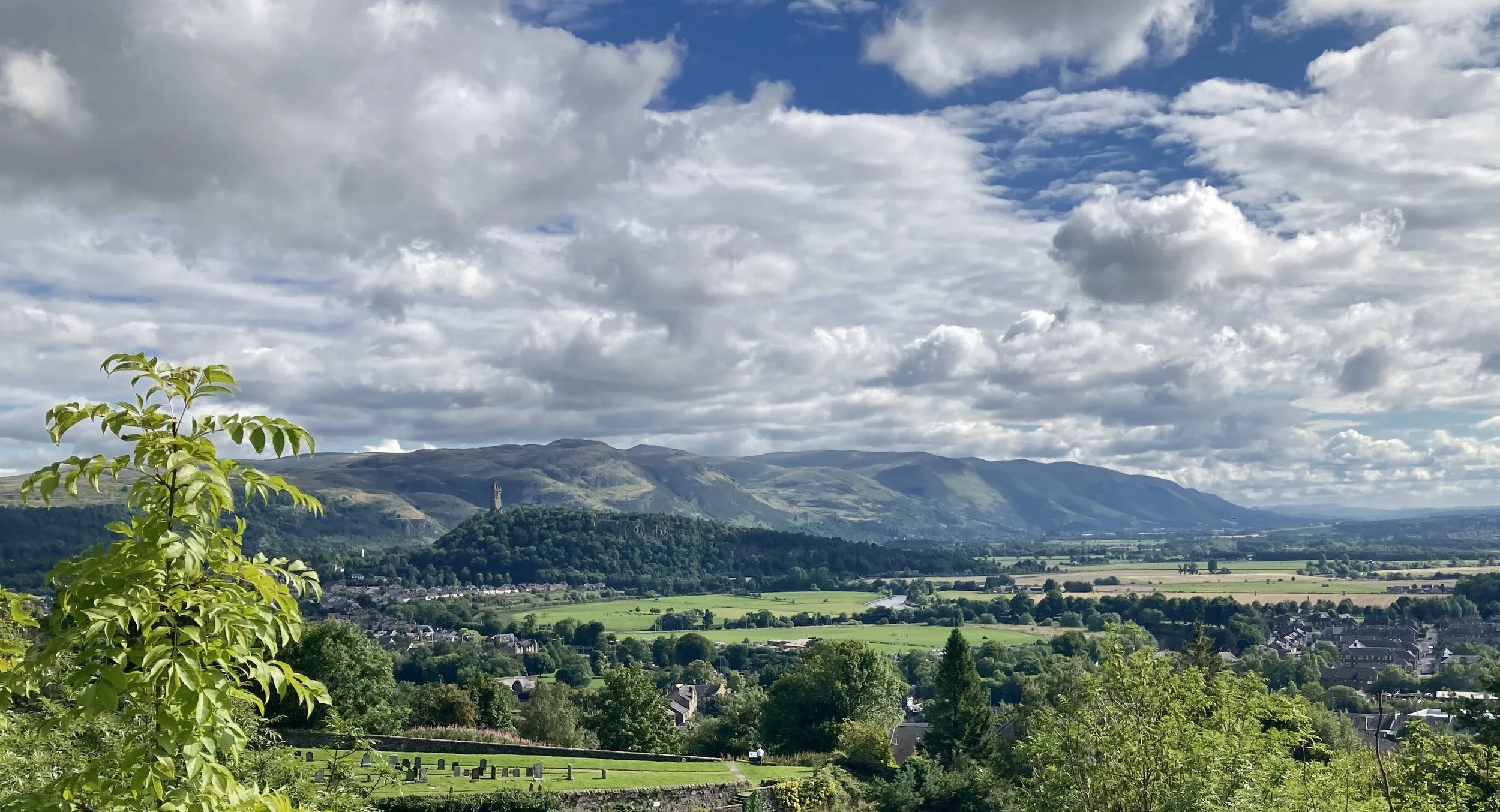
Ochil Hills from Stirling Castle looking east. They stretch from just west of Stirling across to Kinross.
This true story tells of a training day exercise of the Ochils Mountain Rescue Team (OMRT) in Mill Glen above Tillicoultry, between Kirk Crags and Wood Hill, sometime during the 1980’s.
The Ochil Hills (locally simply called, The Ochils) were created some 400 or so million years ago by a series of andesitic (fine-grained, intermediate volcanic rock) lava flows. They form a long east to west range of rolling hills, dropping gradually away to the north. Their steep southern aspect however is very different and reflects the line of the large Ochil Fault, separating the hard, massive volcanic rocks from the softer coal-bearing Carboniferous sedimentary rocks. Silver mining was popular till a few years ago. That south flank is penetrated by short, steep sided gullies or small ravines.
Sea level rise after the melting at the end of the Ice Age, resulted in the flat area in the photograph above being under sea water until circa 6,500 years ago. Subsequent glacial rebound caused the land to rise and retreat the sea, leaving flat clay and peat lands across the whole of the area.
In the 1980’s and early 1990’s, I was a member of the Ochils Mountain Rescue team. We trained at least one full day and one evening every month. Training was varied and included, navigation, hill search techniques, rope and stretcher work and more. An important aspect of all that training involved team building and trust. An exercise that married much of the above was the Tyroleon Traverse rescue.
The technique, as I understand, was originally developed by Tyrolean mountaineers in the Dolomites of northern Italy in the late 19th to early 20th century, hence its name. It is principally used to cross free space between two high points, using a rope or ropes and relies, most of the time, on gravity. Since then the its use has spread to other areas, including caving and mountain rescue. Mountaineers developed the technique for their own use, particularly, although not exclusively, to cross ravines.
The Dolomites of the South Tyrol is a world-famous mountain area containing spectacular peaks, such as; Ortler, Gran Zebru and Monte Cevedale, all towering to somewhere approaching 3,900 metres (13,000 feet)or so in height.
Due to the beauty and special geology, which gives an insight into several different stages of the history of earth, the Dolomite mountains were officially added to the World Heritage Site list on June 26, 2009.
Makes one wonder why our modest wee rolling Ochil hills, maximum height of 430 metres, about 800 feet, qualified us to even consider such a world famous technique. But size was no obstacle to our team and we, undaunted, planned to launch into the unknown and affect a rescue exercise by use of the Tyroleon Traverse.
Impediment one; finding a suitable place in our wee rolling hills to traverse with such a technique?
After a few days of pouring over maps and excursions to possible sites, the Training Team exclaimed, we have the very place, Mill Glen, situated above the quaint and unsuspecting Hillfoots town of Tillicoultry.
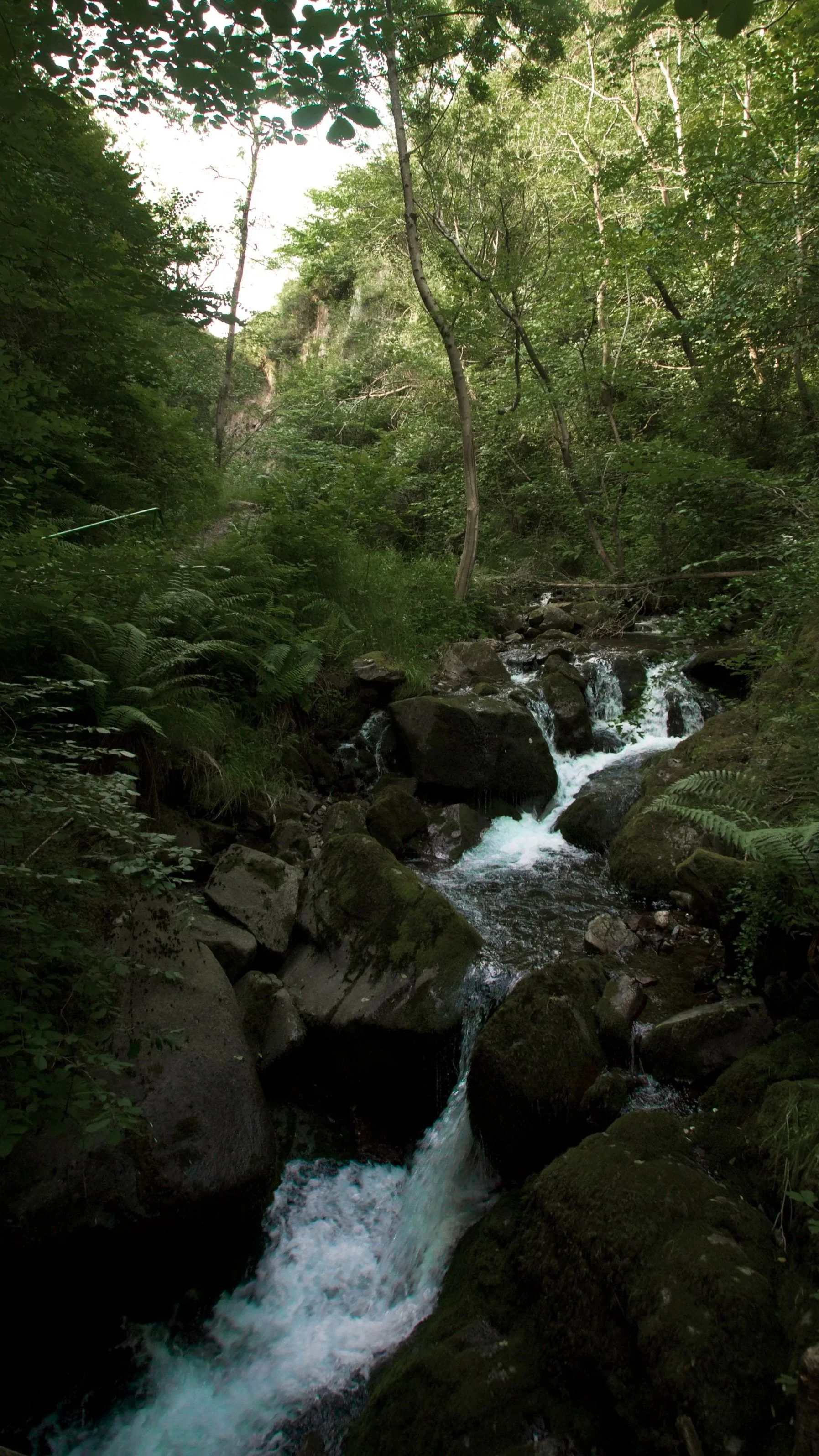
Mill Glen a few years after or traverse.
Impediment two; find a gullible guinea pig, sorry, team member, to trust us enough to be the casualty for this experiment?
The selection process was sudden and decisive. It seemed the perfect candidate had to be, not too tall and a bit chunky. All present were carefully scrutinised before that day’s team leader announced; ‘Ian looks like you fit the bill and more importantly, the stretcher.’ I looked around for any other team member called Ian. If there was, he was absent. I did detect sighs of relief.
And so it came to pass and on that fateful day I was in the group that, carrying the stretcher, went to the top of the Mill Glen, crossed over the burn to the west side before carefully picking its way back down the glen on precipitous ground above the steep sides of the gorge, looking for a suitable spot to rehearse our many, if mostly hidden, talents. We eventually found a suitable spot at the top of an area of sheer cliff, where we commenced setting up the belay.
Meanwhile, on the other side, a bit lower, the ‘stretcher reception’ team sorted out their ropes. The process involved a bit of ‘to-ing and fro-ing’ across the gorge to get the ropes in the correct position. Before securing the ‘running rope’ at the launch end of the traverse, it had to be run through both pulley wheels, which were then affixed to the stretcher, one at the front and one at the back. The ‘running rope’ was then belayed to two convenient trees and we were ready to launch our Tyrolean Traverse experiment.
I was never convinced we would ever use the technique in rescue, but it was a seriously good method of engendering technical skills, trust and working as a team.
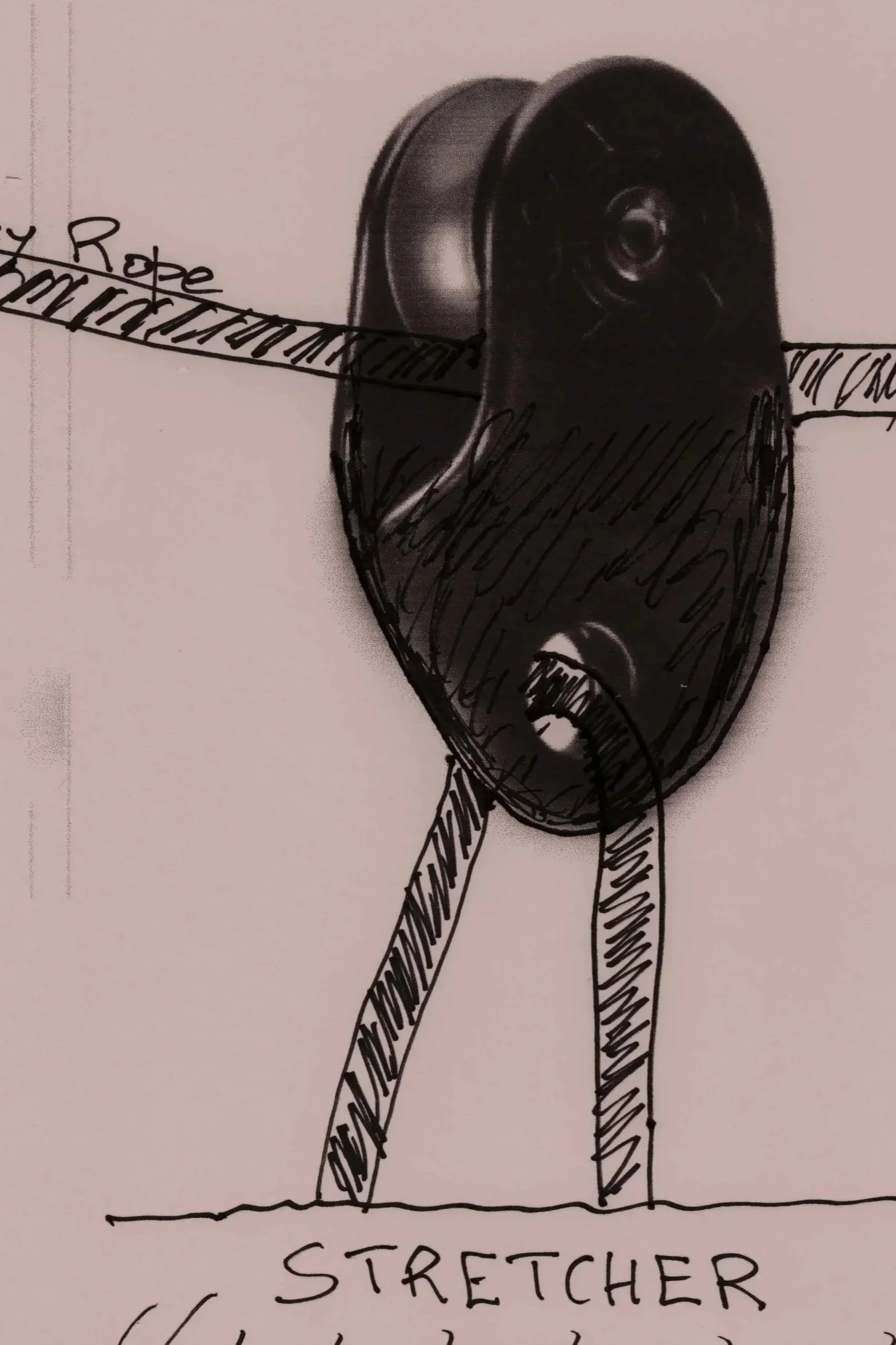
Hand sketched pulley wheel image
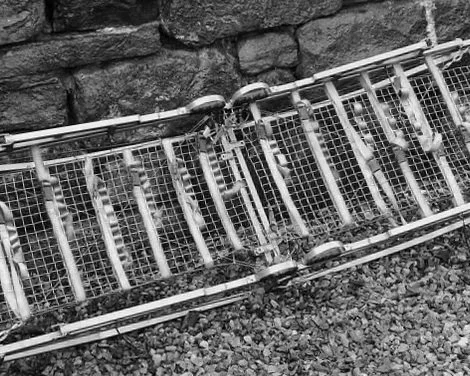
Stretcher similar to the one we used.
The secured stretcher was ready for action, precariously perched on said rocky outcrop at the edge of a vertical drop into the ravine. The ‘running’ rope was checked a few times and declared fit for purpose. That is the rope the stretcher will move along till it gets to the other side of the gorge. Then it was time to sort out the stretcher and secure the ‘casualty’ in it. As I gingerly climbed in I was asked, ‘arms in or out’? In other words when I was securely strapped into the stretcher, did I want my arms outside the strapping to allow me to move them about and perhaps wave at passers by. Understand, if the stretcher was to crash down with me in it, having my arms free would not help. I elected to be fully strapped in, arms as well.
After donning and securing my climbing helmet I climbed into the stretcher and was duly strapped into place. I could not see much but was able to listen to the commentary of the team as instructions were issued. I definitely felt the jerking movements as the stretcher was lifted from lying ‘side on’ to the gorge to ‘facing’ across the gorge. It is a heavy, awkward and dangerous manoeuvre, with team members themselves teetering on the edge of the cliff, whist lifting and swinging the heavy stretcher and occupant round into the correct launching position, making sure not to dislodge the pulleys. Just as I thought, ‘yes, they have got it’ the stretcher was dropped onto the hand of one of the team. He let go with an expletive, and the lifting ceased for a bit till a suitable substitute took his place and the ‘wounded’ retreated to a safe spot to nurse his damaged hand. Then we were on the move again.
If I thought getting strapped into the stretcher and lifted to the cliff edge, with my arms secured by my sides, was a bit interesting, I had not experienced what was to follow.
I trust my life to the team as they teeter about at the top of the cliff, holding the stretcher in position and checking, for the last time that the pulley wheels were properly in place on the ‘running rope’. They seem satisfied and my launch is prefixed by some more shouted communications, such as; ‘ready at this side’, ’have you got that belay tied up at your end,’ ‘is it tight enough,’ ‘don’t move Ian,’ ‘are you ready on the far side?' Regarding the comment, ‘don’t move Ian,’ I had to smile. I was trussed up in the stretcher like a chicken and was moving nowhere.
Then I was off and launched over to the edge of the abyss, snuggled inside in my comfy stretcher.
Disconcertingly, the first sensation I felt once released and clear of the cliff edge was a violent and, dare I say, alarming, sensation of plunging wildly into the abyss. Tyrolean traverses can, depending on the tension in the rope, sag significantly once weight is added. I can attest to that. That feeling of uncontrollable descent is then replaced by a moment of uncertain relief as it is arrested for an instant before being replaced by a sudden bounce back up towards my launch pad, then down again and then up, oh, and down again, and up again for a while, before eventually settling.
Then we are moving and making progress. As I lie looking up at the single rope, the umbilical cord to which I owe my survival, the stretcher is moving slowly, being pulled from the lower far side, the rate being controlled from the 'launch' side by a different rope. So far so good. Then it all went 'tits up,’ to use a military term. The swaying and gentle bouncing has somehow dislodged the front pulley wheel from its running position on the rope and jammed. Yes, in front of my eyes.
Helplessly strapped in the unbudging stretcher, above a roaring gorge and oblivion, I can do nothing, except watch the rope as I spin round and round and at the same time, in perfect harmony, bouncing up and down, for what seemed an eternity.
Meanwhile my team mates are shouting back and forth to each other across the gorge, as they desperately seek a solution. I gaze up at the dislodged pulley wheel, wondering how long will it take for the rope to snap. It is funny how shouting, swearing and telling me to lie still and not panic, seems to be the universal method for sorting out these situations. I did not panic, no reason to, there was absolutely nothing I could do. In fact I could not get my arms free anyway.
They never did manage to get the pulley wheel back on the rope and resorted to brute strength and a lot of heaving, controlled by even louder shouted instructions, during which I was jerked hither and yon. My vision of the rope breaking had not left me and was increasing by the minute. I watched as the sheath started to fray and thought, ‘hmmm, that does not look good’.
Ten minutes or so later I was at journey’s end and watched with interest as eager hands grasped the stretcher and unceremoniously dragged me over the edge before, with sighs of relief dumping the stretcher, and me, on the bank. I was then released from my 'mummy' outfit and all was well.
The rope was destined to the damaged equipment cupboard.
No guinea pig was harmed during this misadventure.
Exaggerated tales were later circulated over a refreshment or two, later that day in a Tillicoultry pub, The Woolpack.
I am not sure that daring technique was ever attempted again.
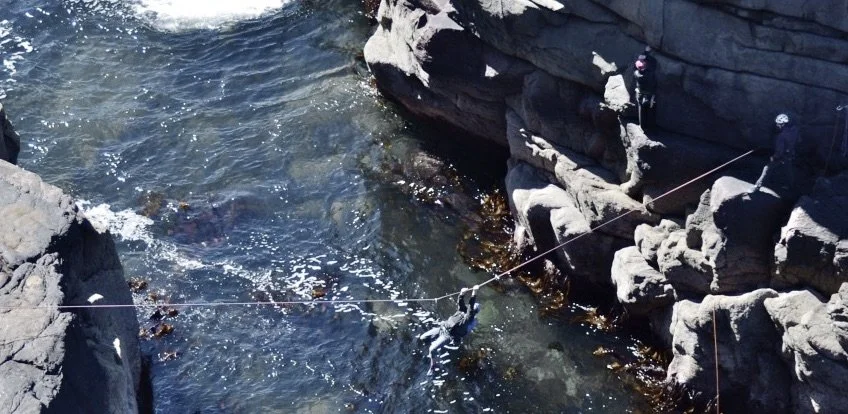
A different day as a climber traverses to The Old Man of Stoer - image taken by author.
Footnote; some years later, 1993, a film called Cliffhanger hit our cinema screens. In it, the main character in the film, Sylvester Stallone used a Tyrolean Traverse with tragic result. If that film had come out some years earlier perhaps that training exercise might have been re thought?