Who Was Danny Faulds?
I have known Danny Faulds for over 70 years but until recently I had no idea who he was!
Earlier this year, 2026, I was asked by the Co-ordinator of, Creative Veterans, a group I am involved with, to ‘unearth’ stories of three soldiers who had served in the Argyll and Sutherland Highlanders Regiment (The Argyll’s) and write a presentation to perform on 1st May 2026, at the Carnival of the Wolf, on Culture Night Stirling. An event to mark the 900th anniversary of Stirling becoming a Royal Burgh. If possible, the stories had to be about soldiers not previously widely known. I think the request referred to them as ‘forgotten heroes’.
The request came from the Archivist at Stirling Castle Museum. Stirling Castle is the ancestral home of The Argyll’s and their history is archived and displayed in the castle.
The Argyll and Sutherland Highlanders, one of the famous Scottish Infantry Regiments who sadly, in my opinion, no longer exist. Politics and finance being the reason. They, as well as The Seaforth Highlanders and all the rest of the Scottish ‘line’ Regiments were disbanded a few years ago and amalgamated into one unit, The Royal Regiment of Scotland.
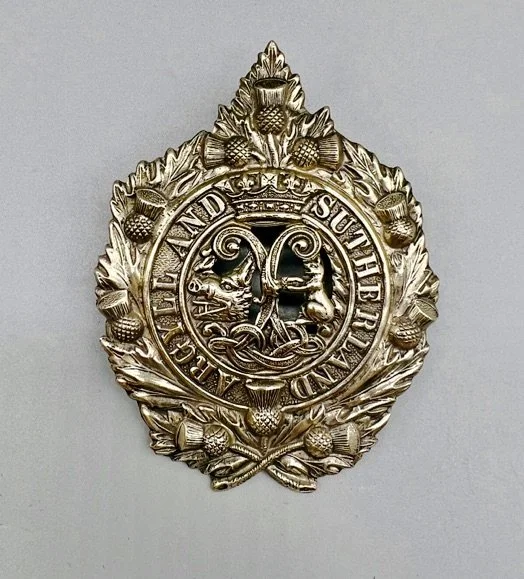
Argyll and Sutherland Highlanders cap badge.
So why did I select Danny Faulds and who was he?
The first part is easy, but to explain his inclusion I will first tell a bit of dad’s war. Coincidently, at that time, I was writing and posting on this site, my dad’s war experiences, under the title; STORIES FROM WORLD WAR TWO, in four parts.
My dad, Thomas Barbour McNeish, was a private infantryman in the Seaforth Highlanders Regiment (The Seaforths) during World War Two. The Seaforths, part of the 51st Highland Division was initially stationed near Metz in Northern France, defending the Maginot Line. In the late Spring, early Summer of 1940, the German Panzer Divisions invaded France through Belgium, overrunning the British supported French defences.
Unknown to many of the 51st Highland Division, certainly those in the lower ranks, that while they were fighting alongside the French and being overrun, the bulk of the British Expeditionary Force was being evacuated from Dunkirk, from 26th May until 4th June.
Meanwhile the 51st HD, still in France and still supporting the French troops, found themselves battling south and west through France, roughly along the line of the Somme, heading for Le Havre, with the intention of evacuating back to Britain. That operation was prophetically named, Operation Cycle.
Dad once remarked;
‘it was called Operation Cycle because we were on our bikes trying to stay ahead of Rommel and his Panzer Divisions.’
Bikes or no bikes, it made no difference, on the 12 June, having been outflanked and cut off from Le Havre, most of the gallant 51st were captured at St Valery en Caux and became Prisoners of War. That is how dad finished up at Stalag XXA, Toruń, Eastern Poland.
As referred to earlier, a short four part, account of dad’s war, STORIES FROM WORLD WAR TWO, appears in this website.
After the war, dad refused to claim his medals.
What he did retain however were the following:
A serious resentment about the mass of publicity that surrounded Dunkirk, whilst hardly a mention was made about the rearguard action of the 51st HD and its eventual capture at St Valery en Caux. Even in Scotland. An action that aided the Dunkirk evacuation, by dividing and diverting the invading forces away from Dunkirk.
Physical scars on his forehead and leg, a Colt .45 Smith and Wesson revolver with ammunition and last but not least, a small black and white photograph; the funeral of a fellow prisoner of war and friend; Danny Faulds.
An image included in Part Three of Dad’s war experiences.
After dad died in 1974 I fell heir to that photograph.
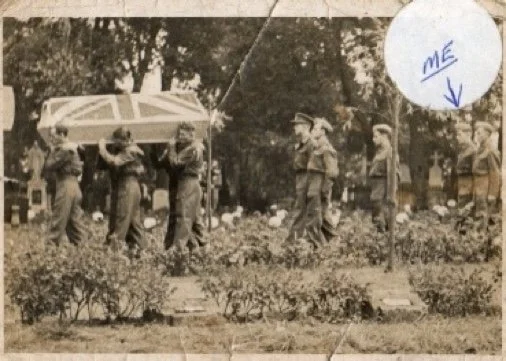
Funeral of Danny Faulds
Back to the request from the Archivist at Stirling Castle Museum. Whilst searching about for suitable material for that request I thought about Danny Faulds. You will recall, apart from knowing he was a prisoner of war beside my dad and that he died and was buried whilst in captivity, evidenced by the photograph, I knew nothing else about him.
Anyway, I thought, let me find out about dad’s friend. I had the photograph, I had the prison camp name and I had his name, Danny Faulds. It seems strange somehow that name had stuck with me for more than seven decades. I have no idea why. It was like he was one of my family. Perhaps it was my attempt to hold on to my dad who had died so young and who I idolised. I was now motivated to find out more about Danny Faulds.
After some computer ‘search engine’ work I came across an organisation called, History Recon, who trace soldiers from the two world wars. The organisation was created by military historian Matthew Holden, who now leads a research team specialising in British Army service during the World Wars. Drawing on archival sources, regimental histories and wartime records, History Recon helps families reconstruct the wartime experiences of their ancestors. www.historyrecon.co.uk
I contacted them with the little information I had. About two weeks later they responded with information about Danny Faulds;
At the onset of World War Two he had enlisted into the army as an Argyll and Sutherland Highlanders, 7th Division. Army Number - 2983703. They were also able to inform me that Danny died while in captivity at Stalag XX-A on 22 Sept 1942 of Broncho Pheumonia. He was 26 years of age.
I next carried out some research with Scotland’s People, the online face of The National Records of Scotland, where one can search for record of Births, Deaths, marriages and much more. www.scotlandspeople.gov.uk
Amongst the information I gleaned from that source was that he was born in The Haggs, a small village in Stirlingshire, on Dec 15th, 1915. He was schooled locally and on leaving school he followed in his father’s footsteps and became a coal miner. I also discovered he was a keen football player.
My next source of investigation took me to a pen friend in Eastern Poland, Sylwia.
She has a keen interest in the allied prisoners of war who were incarcerated in the east of Poland.
Sylwia was very helpful and filled in even more spaces in my knowledge of Danny Faulds.
Details of his burial locations;
After his death in 1942, place and map reference; Thorn Q.54/ J. 37. (As photographed)
On 17 Nov 1948, reinterred to Malbork Military Cemetery, Q.55/ D. 79. (Plot Vl - B - 2)
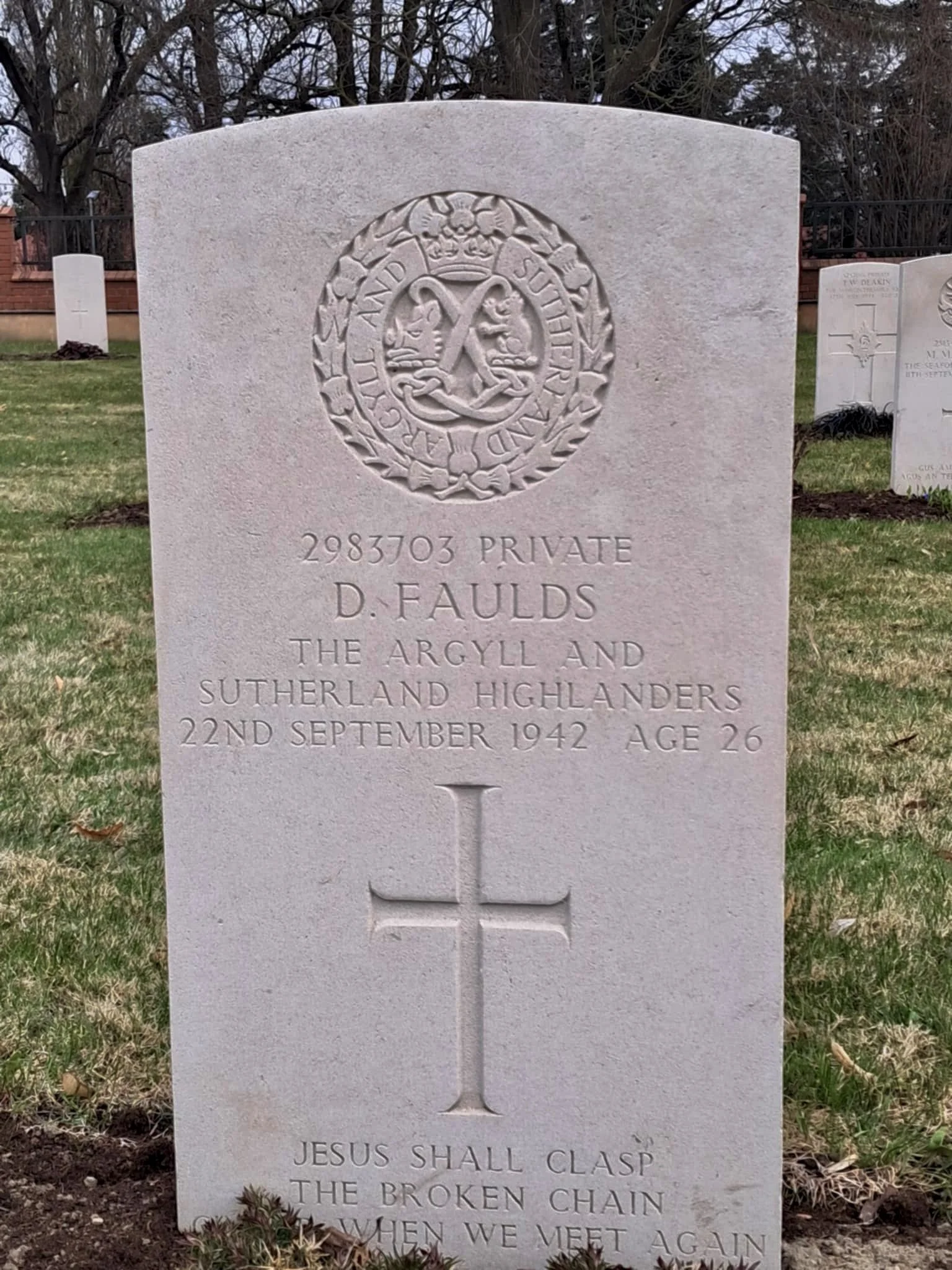
Danny Faulds last resting place, Malbork Military Cemetery - Plot Vl - B - 2
And that was it, I now knew about Danny Faulds. He had been an Argyll and therefore could form part of my presentation. Job done.
But the job was far from done. There was more to know about Danny Faulds, I had just found relevant dates etc, but who was he?
He was not just a football playing coal miner, he was more than that.
As well as being friends with my dad in the Stalag, he was also friends with Sam Kydd, actor, incarcerated in the same camp. Sam, an army officer’s son, was an actor in civvy street and appeared in more than 290 films. He was a character in Orlando and appeared in Coronation Street, a long running British ‘Soap’. He organised most of the entertainment in the Camp and Danny played in the musical group.
Sam wrote a book about his war, entitled ‘For You the War is Over’.
In that book I found more about the real Danny Faulds. I discovered that he was musical and a talented drummer. I found out that he participated in the camp entertainment sessions. Sam organised most of the shows and extravaganzas in the Camp and Danny played in the musical group. Danny also played in the football team for his hut.
Sam wrote;
“About the second week in September, 1942, there occurred the greatest tragedies of my POW time. It happened so suddenly that even as I write this I’m still confused and bewildered how it occurred.
Danny Faulds, a very close Scottish friend was taken ill with a sore throat and heavy cold. Within a week he had died. I, we, couldn’t believe it.
I was terribly cut up about his death; it was as if my own brother had died.
Numbers at his funeral were limited, only some close friends, otherwise half the camp would have been there. I was one of the pall bearers. The procession through the streets of Toruń was impressive, only thing lacking was a piper. Rarely can we say of a man that he was universally beloved, but no one will ever deny to Danny Faulds the right to have claimed the sincere affections and respect of all who were fortunate enough to come into contact with him. He will be remembered by everyone as a drummer, but he had more, his unerring and illuminating strokes with brush or pen and his skill and immaculate sportsmanship on the football field, his quiet charm, his sense of humour, his patience and conscientiousness and strength of character on display in good times and bad.
Poor Danny we miss you. They don’t make them like you nowadays, well, if they do they are awfully hard to find”.
Both Sam and Dad, who met at reunions after the war spoke fondly of Danny.
I leave the last word on Danny to my dad, “ When Danny was laid to rest and they played the last post, we, hard fighting men, who had seen a lot of death, wept”.
Danny Faulds was an ordinary young man from an ordinary working class village, who joined up with thousands of other ordinary young men to tackle a virus that was sweeping through Europe.
But he was not ordinary, none of them were ordinary.
They were far from ordinary. They, every last one of them, were hero’s, latter day paladins.
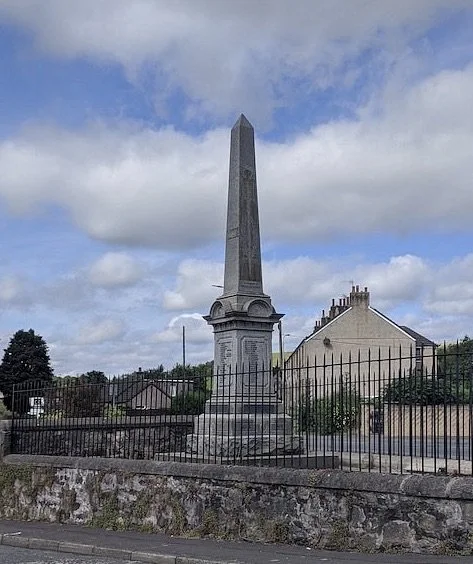
The Longcroft War Memorial where the name Danny Faulds appears.