malcolm allan, mess room boy
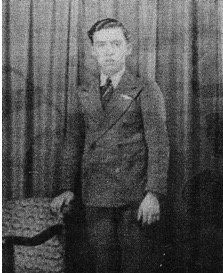
Malcolm Allan
This a true tale, involving a loving sister ( my aunt ) and her big brother Malcolm.
Many, if not all, towns and villages throughout Scotland have places where the names of military personnel and others from the area who were killed whilst serving their country are displayed and where, on Remembrance Day in November each year, locals gather to remember and honour their sacrifice.
The village of Bonnybridge in Stirlingshire is no different.
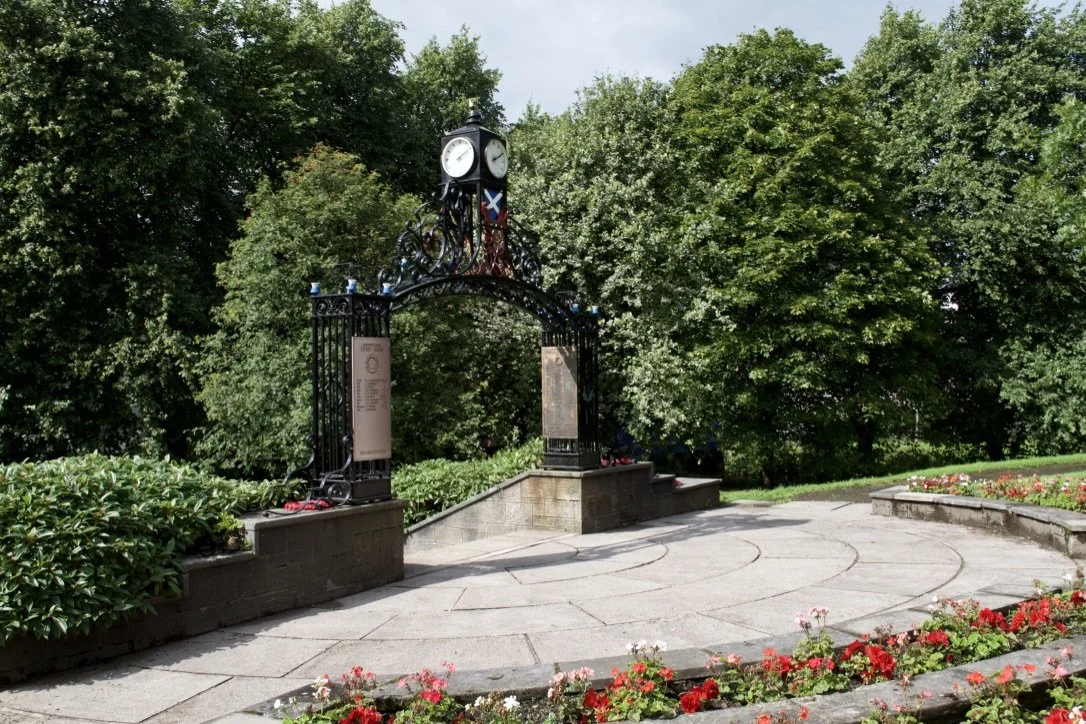
Remembrance Garden Bonnybridge
Florence Allan or O’Hara, my aunt, and a resident of Bonnybridge for most of her life, attended every remembrance service held there since the end of the second World War to remember her brother, Malcolm, killed during that conflict. From 2016 until she passed away in 2019, illness prevented her continued attendance.
I regularly visited my aunt at her home in Bonnybridge. During a visit in late 2017 I noticed a large bouquet of flowers and asked what was the occasion. She told me the flowers were presented to her by the Provost of Falkirk Council because of her seventy years of unbroken attendance at the Bonnybridge Garden of Remembrance Service in memory of the fallen. It was then she told me about her brother Malcolm, who’s name was on that plaque for the fallen. That was the first time I had heard the story.
This is what she told me that day;
When war broke out, Malcolm was too young to join the military so, at 16 years of age, he went into the Merchant Navy. Florence had no memory of his first ship or where it had taken him. She was aware however that on his return from that maiden voyage her big brother Malcolm was frightened. He therefore did not go back and stayed at his mother’s house in Bonnybridge. After a few days, Florence cannot remember how long, two civilian police officers called at their house and arrested Malcolm and marched him down the hill from the house to the local police station. While Florence has only a few snatched memories of that day, she clearly recalls her brother being taken from the house and the name of one of the police officers who took him, Sergeant Fraser. She says she will take that memory to her grave. That was the last time Florence or any of his family saw Malcolm.
Malcolm’s second ship, she told me, was the MV San Delfino, on which he was the Mess Boy. It was attacked and sunk and Malcolm was killed. She had no other knowledge of the circumstances of her brother’s death.
She then went on to tell me about Malcolm and her family.
Malcom Allan was born in 1925 in Calton, or as it was previously known, Caltoun, an area to the east of Glasgow City centre where many Irish immigrants lived. There are records of early brick making in the area although that changed through time and it became better known for weaving. Many of the earliest Irish immigrants arriving in the area were weavers therefore their textiles knowledge made them highly valued by local weaving organisations.
By 1819 about 30 per cent of the area's weaving population were of Irish origin. The Great Famine (1846-50) saw another exodus from Ireland and many headed for Scotland. By 1851, the Irish-born population of Scotland had reached 7.2%. In Glasgow it was 18.2%
Even earlier, in 1787, Calton weavers became involved in industrial strife with their employers, resulting in a bloody outcome. It has been claimed to be the first industrial conflict in Scotland. Government forces were brought in and they shot and killed six of the striking weavers.
That incident, forever to be called, the Calton Weavers Massacre is commemorated in a song, The Calton Weavers. I like Hamish Imlach's version.
Over the years the weaving industry waned and many families of Calton were reduced to living in poverty. This was recognised by the World Health Organisation and in 2006 one study suggested that Calton residents had a life expectancy of 53.9 years, less than many residents in the middle East, Palestine being cited.
If that was not bad enough, there were the other tensions afoot in areas of Glasgow as the twentieth century rolled on. Sectarianism. A tribal gangland culture emerged and ‘the Calton’ was not immune, giving birth to the Calton Tongs, with their war cry, Tongs Ya Bass, giving rise to a new moniker for the area, Tongland.
In 1925, Malcolm Allan was brought into that world in a Calton tenement block in Suffolk Street. Six years later his sister Florence was also born in the same tenement. They were raised into that mix of influences; history, conflict, culture and poverty. Florence had eight siblings, including Malcolm. They were not from Irish Immigrant stock, however one day, in a place she would never have heard of in her Calton days and in a different life, Florence would marry into Irish Immigrant stock and through that marriage to my mother's brother she would become my aunt.
Florence was eight years of age when war was declared on 3 September 1939.
On the 2 September 1939, the day before war was declared, Florence, her mother Jeanie, her sisters and two of her brothers were evacuated from their home in the Calton. They were not alone. Children the length and breadth of Great Britain were being evacuated from cities identified by the Government as likely targets for enemy air attack. They were taken to 'safer' areas. Many families from Calton were loaded into coaches that day and taken out of Glasgow to a new world. In the case of the Allan family, part of it, that new world was the village of Bonnybridge in Stirlingshire.
It was situated on the Forth and Clyde canal and was the centre of iron foundries, the famous Rayburn Stove, clay mines and brick making. It was also on the forefront of what had been a different and markedly more ancient conflict, between the Roman Empire and the northern Britains as it lay immediately adjacent to and abridging in some spots, Antonine's wall. But that's a conflict too far.
While her father and brothers stayed on in Suffolk Street, the rest of the Allan family was housed in a barber's shop, or perhaps one should refer to it as a hairdressing salon, in a tenement in High Street, Bonnybridge. So they in fact moved from Tongland to Tongland I suppose? The barber and owner of the shop was Allan Gillespie. He was absent on war duties. The Allan family was informed they would have to move out when the owner returned.
Their new home, according to Florence, was good in so many ways. There was plenty room for the family and it had so many sinks. In fact she had never seen a house with so many sinks. All these years later her abiding memory of the house was the abundance of sinks, giving rise to Florence, only eight years old then, thinking that this was common in Bonnybridge and that it must have been the cleanest place in the world. The other advantage of their new home, it was between McGregor's shop on one side and Marcella's chip shop on the other side, a perfect location. They settled in and life moved on.
The war raged on and in June 1940 two momentous things happened. The British Army was routed and the majority had to be evacuated from Europe at Dunkirk. That same month the 51st Highland Division, for strategic military and political purposes, was sacrificed at St Valery en Caux and most were taken prisoner. My father, a Seaforth Highlander, became a prisoner of war. I was not born at that time.
The Allan family, certainly Florence and her siblings, would be unaware of these goings on and continued to create a home in their new world with all the sinks. In 1942 they became more aware of the war, if even in a child's way.
Back to my visit in 2017 and the flowers.
I promised Florence I would do some research and on my next visit, as well as eating her Empire biscuits, I would let her know what I had found out. She asked me to promise I would do that for her.
Malcom’s story;
Malcolm was mess room boy on the MV San Delfino an 8,702 ton armed British tanker, en route from Houston to Halifax with a cargo of aviation spirit when she was torpedoed and sunk by U-boat 203 on 9th April 1942 off the coast of North Carolina, near Cape Hatteras. Out of a crew of 49, they lost 28, including Malcolm Allan the 17 year old mess room boy who was on his second voyage.
He would never return to the Calton nor the new world of Bonnybridge, nor would he see his dad Robert, his mum Jeanie or his brothers and sisters again. Ironically he died close to another new world, United States of America. About a month later the body of Michael Cairns, Fourth Engineer of the MV San Delfino was washed ashore at Buxton Wood, Hatteras Island on the Outer Banks of North Carolina. His body now lies, along with a sailor from the HMT Bedfordshire, sunk some time later in the same area, in The British Cemetery, Hatteras Island. No other bodies were recovered. Annually there sacrifice is remembered at an annual memorial service by members of the National Park Service, who maintain the graves, the US Coast Guard and the Royal Navy.
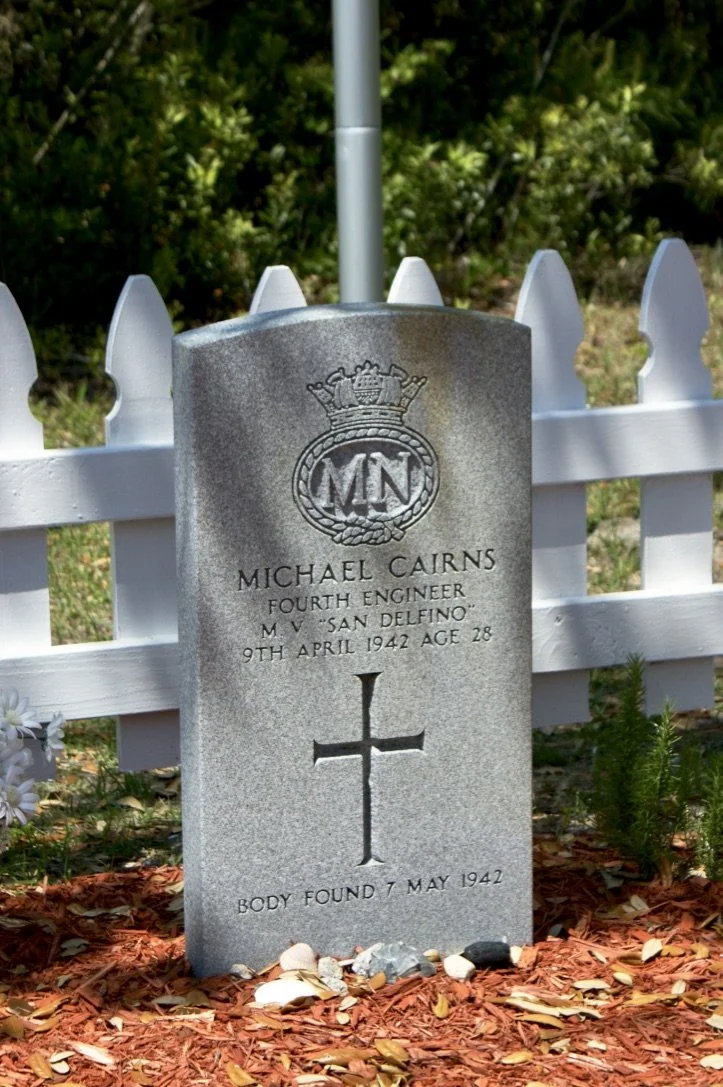
Gravestone of a San Delfino sailer at Buxton, North Carolina.
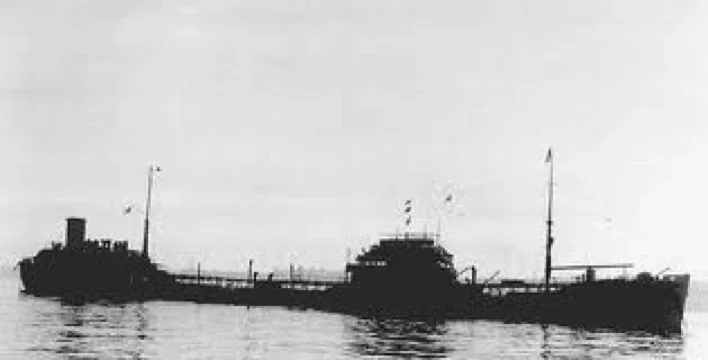
San Delfino - (Delfino means Dolphin in Spanish)
San Delfino was built by the Furness Ship Building Co., Ltd., Middlesborough, United Kingdom in 1938. Hull number 283, owned by Eagle Oil and Shipping Company, London.
At a depth of 110 feet, the wreck is a popular recreational dive site. The wreck is mostly intact, though angled over to starboard. A large propeller exists, as well as a large deck gun. The engineering spaces are disarticulated with various areas of high relief. This wreck site is known locally as the "green buoy wreck."
Before the war, the tanker San Delfino worked routes from Mexico, the Gulf of Mexico, and the East Coast of the United States to the United Kingdom. At the outbreak of World War II, San Delfino underwent conversions to add a 4-inch deck gun mounted at the stern and four machine guns located both fore and aft. The vessel also carried two Hotchkiss machine guns and a Lewis machine gun, making it a formidable opponent to any U-boat.
Soon after Germany declared war with the United State on December 11, 1942, the German U-boat commander, Vizeadmiral Karl Dönitz, began plans to strike a swift and devastating blow on the United States' eastern seaboard. His plan was called Operation Paukenschlag, also known as Operation Drumbeat. In late December, five U-boats set sail and the first torpedo strike occurred on January 11. In early April 1942, Operation Drumbeat continued with a fourth wave of U-boats, including U-203, which arrived off the East Coast shortly after a fuel stop in the Azores.
In the early morning hours of April 9, 1942, as U-203 patrolled the waters, it spotted San Delfino traveling alone from Houston, Texas to Halifax, Nova Scotia and on to the United Kingdom. U-203 fired one torpedo, striking the starboard side near the number two or number three tank, instantly igniting some of the 11,000 tons of aviation fuel carried by San Delfino. A second explosion erupted, possibly from either the ammunition cargo or the weapons on board. Flames ignited all over the vessel.
The call to abandon ship was made and two lifeboats were lowered. One of the lifeboats, however, got caught in the current and was dragged into a pool of burning fuel, horrifically killing the 24 crew members and four gunners in the boat. The master, 19 crew members and two gunners in the other life boat were picked up by HMS Norwich City (FY-229) and taken to Morehead City, North Carolina. Of the 50 crew members on board, 28 lost their lives as a result of the attack.
Most of the information gleaned, I did not pass on to Florence. I did tell her the date of the sinking, location, the existence of the Buxton Cemetery with the San Delfino connected grave as well as the annual remembrance ceremony.
Florence was heartbroken when I told her of these things. Until that moment she had no idea where her beloved brother, the one she had never abandoned and had cherished his memory since she was a child. Through her tears she said,
‘Oh my goodness Ian, all these years and I thought he died in the North Sea, close to Scotland. I had no idea he was so far away from us. If I had known about the cemetery in America when I was younger and in better health, perhaps I could have visited and properly said, good bye Malcolm, I love you. Such a long way from Tongland’.
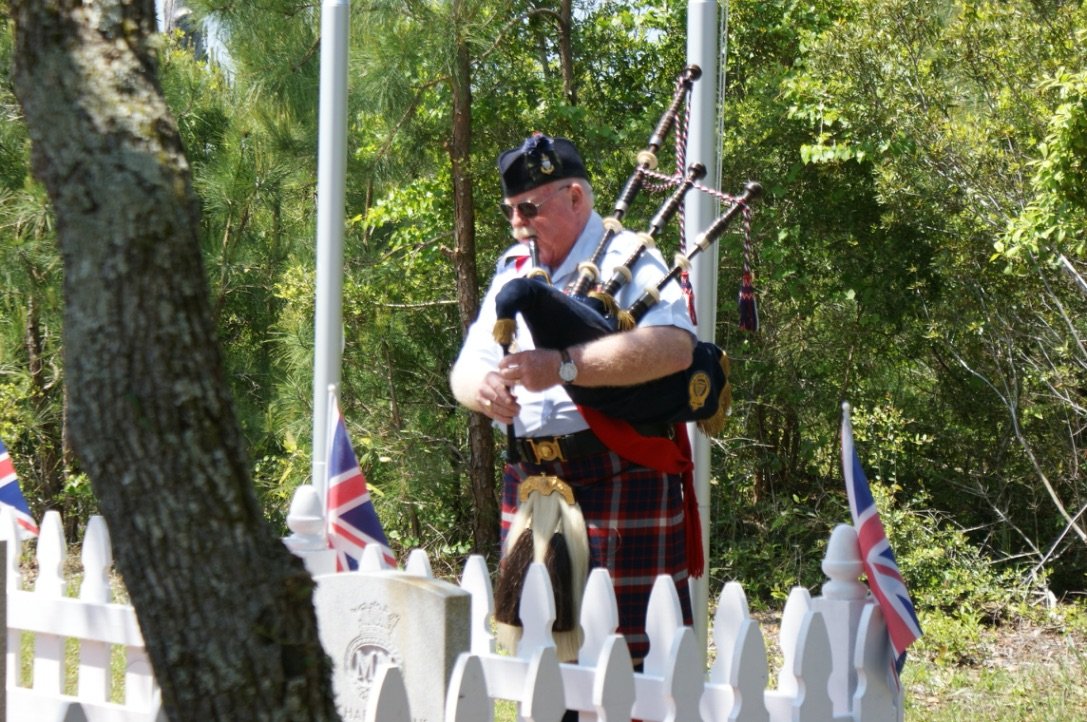
Buxton piper