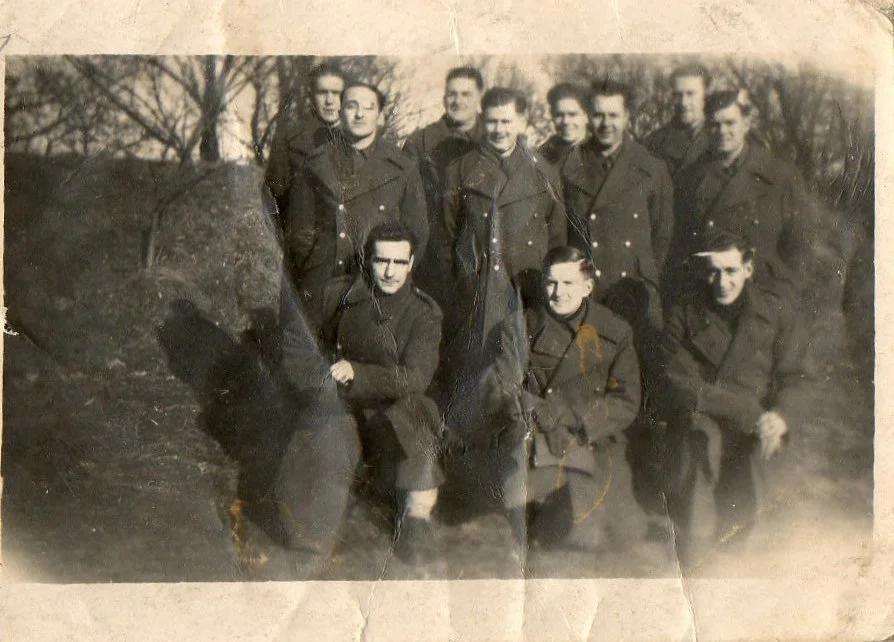
Toruń Prisoners of War - with greatcoats - Tom Barbour McNeish smallest in back row.
This is Part Four and the final part of my short account of the war exploits of Thomas Barbour McNeish, my dad, referred to from here as Tom. It is not the official Government version. It is taken from the comments and experiences of two actual front line soldiers, Tom and George, with a short intervention from Jim McNeish, Tom’s brother.
What follows only relates to the Toruń prisoner of war camps in eastern Poland.
Using the same technique I utilised in parts One, Two and Three of Tom’s story, in which I included George Wedgbury and Don Smith’s exploits, this time I have only George’s exploits to add as Don was not imprisoned in Poland. Nevertheless, it is still my intention to give the reader a slightly wider understanding of what soldiers endured in their fight against oppression than I could have if I were to rely solely on Tom’s ‘utterings’ on the subject. He really did not speak much about the ‘long march' experience, other than a few short snippets.
George’s final journey to freedom was not the same as Tom’s, so unlike the first three parts, this final section, Part Four, is a bit different. I have also included Jim McNeish’s route to freedom, again to give the reader a wider view of how some soldiers risked all to escape.
I start with the statement of V. HÖVEL, COMMANDANT of Stalag XXA, Torun Poland . Made to Captain G. HAY on 8th February 1946 after his capture.
The March of Stalag XXA from Thorn to Zarrentin ( 20 Jan to end of Feb 1945 )
“During the night of 19th / 20th January, I received an order to leave THORN on the morning of 20th January with the inmates of the Stalag and to proceed in the direction of BROMBERG.
Months before, an operational order had been prepared for this eventuality and everything had to conform to this order. The detailed orders for the preparation of this order had come from the Commandant of Prisoners of War, Generalmajor IHSSEN, in conjunction with the Commandant of the training camp at THORN. Oberstleutnant von TIEDEMANN had been nominated as the officer responsible for the preparation of this order at the Stalag.
In view of the rush of work which a new Commondant has to go through, I did not find time to study the operation order, but got Oberstleutnant von TIEDEMANN to give me a gist of it. Later on, I studied the operation order in detail. But at the time of the departure I was not completely conversant with its details and, therefore, Oberstleutnant von TIEDEMANN remained responsible for the departure in accordance with the operation order. This actually happened.
This operation order provided for the departure to take place in accordance with the various possible directions of the enemy’s advance.
The actual situation required the Stalag to march on the 1st day, i.e. the 20th January, in a westerly direction to BROMBERG and then further on to NACKEL, where we were supposed to occupy the alternative quarters. Any further orders for the continuation of the march would come from the Commandant of Prisoners of War, Generalmajor IHSSEN. As, however, NACKEL, which is 15 km West of BROMBERG, was already occupied by the Russians on the 20th January, the part of the operation order referring to the continuation of the march was already out of date on the first day, and thus confusion ensued. During the night of 21st / 22nd January an order was received from the Commandant of Prisoners of War to march from BROMBERG in a northerly direction to FLATOW and not to NACKEL. That was the last order from the Commandant of Prisoners of War XX A.K. As from the 22nd January, Stalag had to rely on its own resources, but under great difficulties continued its route still further North and then West - partly by marches rendered extremely difficult through snow and ice - and could then make contact with the Commandant of Prisoners of War at XVII A.K. and later. As the enemy was following close behind - about one day’s march behind us - those first days, that is the time up to the end of January, were very strenuous for the prisoners and the German staff.
With greatest of difficulty provisions were provided, (very often they were in short supply) and accommodation was obtained. The prisoners were accommodated mainly in large barns on farms. As field kitchens were not taken along, kettles etc. had to be taken from the farms to help out. Nor did we have the necessary transport facilities. Many lorries broke down, a great deal of luggage had to be abandoned in order to get on and to avoid falling into Russian captivity. We lost many prisoners flight, illness and hundreds of prisoners lagged behind and were picked up further back by other units or by police patrols. Taking rest into consideration, on an average, 25 to 30 km were covered daily.
As I have no maps at my disposal, I can quote the route only by memory, and, naturally, small errors will occur.
The march began on the 20th January, with BROMBERG as goal. The 21st January was a rest day. We left on the 22nd in a northerly direction towards FLATOW. About 20km North-East of NACKEL, a home guard company with about 1000 prisoners of war moved into billets on 22nd January - I cannot remember the location without a map. During the night of 22nd / 23rd January, this place was encircled by Russian tanks and nearly all prisoners, including several Englishmen, fell into Russian captivity.
The march was continued via VANSBURG, USEDOM, WOLLIN, SWINEMÜNDE, Training Camp at GROSS BORN, BÄRWALDE, BAD POLZIN, DEMMIN in POMERANIA, SCHWERIN, HAGENOW, ZARRENTIN in MEKLENBURG. Arrived there towards the end of February 1945. Here contact was resumed with the Commandant of Prisoners of War at XX A.K., Generalmajor IHSSEN, who had arrived at HAGENOW. ZARRENTIN had been decided upon as the final destination where the Stalag was to wind up its affairs. This meant the handing over of all prisoners of war. These were grouped together into columns and after three weeks were taken to the workshops of the State Railways in MADGEBURG, HANOVER, BRUNSWICK, LEHRTER, STENDAL, HAMELIN and elsewhere and were thus taken off the strength of the Stalag. The Stalag only kept its own soldiers. The reason for the employment at the railway workshops was to place sufficient prisoners of war at the disposal of the railway administration in order to repair the considerable damage wrought on the railway network.
The Stalag received the orders to march via DÖMITZ on the ODER, SALZWEDEL, GIFHORN to the training camp at FALLINGBOSTEL, in order to be finally broken up there. As the Americans were very near us , the Stalag had to depart again via LÜNEBURG to DÖMITZ, where troops had to be handed over for frontline service on the LOWER ELBE sector. The march continued back to ZARRENTIN and then to HAMBURG, where the Stalag was placed under the command of the Commandant of Prisoners of War at X A.K., who ordered the final dispersal of the staff of Stalag XX A. Then a short march to the North of HAMBURG, and, at the beginning of May (1945), I fell into English captivity in the neighbourhood of KENSBURG.
To conclude, I should like to add the following on the subject of the above-mentioned march;
The departure was extremely hurried. Had it been ordered to commence a few days earlier, that is on the 17th or 18th January - and that would have been possible - everything could have been arranged more quietly which would have been to the advantage of the troops and the prisoners of war.
It was a great disadvantage not to have field kitchens or make-do equipment such as kettles for the troops and the prisoners of war.
Ration supply should have been more certain.
Insufficient transport facilities for such long marches with prisoners of war, who were not used to them anymore.
I have made the above statement of my own free will and without compulsion.”
(Sgd) V. HÖVEL
Signed in my presence (Sgd) G. HAY, Capt. L.D.C. 8th February 1946
I now continue Thomas Barbour McNeish’s, World War two exploits.
This is Part Four and the final part of my short account of the war exploits of Thomas Barbour McNeish, my dad, referred to from here as Tom.
The ‘record’ states that Stalag XXA, the main prison camp complex, was evacuated during the 20th, 21st and 23rd of January 1945. Tom’s diary however still has him under lock and key on the 25th of January. I am assuming therefore that he was in a work camp (Arbeitskommandos) on that date and not the actual Stalag, suggesting that the departure from the geographically spread out work camps may well have been on different dates and not at the same time as the evacuation from Stalag XXA. I suspect that Tom and George were in different locations at this time.
Due to these different starting points and dates, coupled with the fact that the Russian Army was infiltrating the whole area, it would appear not all prisoners from the Toruń area travelled in one group, nor did they all take the same route. In fact George and Tom’s war finished on very different ‘routes’. I have also taken the liberty of including my uncle Jim’s final days of captivity. (Tom’s brother who was also captive in Stalag XXA, Torun)
Many of the memoirs of POWs who took part in the ‘Long March’ have been published or recorded over the past eighty years, The experiences of George and Tom are not amongst them.
The March, the Long March, The Death March and more, as variously named by different participants, was I suspect, a brutal and unnecessary display of defiance by Germany and because of it, many hundreds, some say, thousands, died for no good reason.
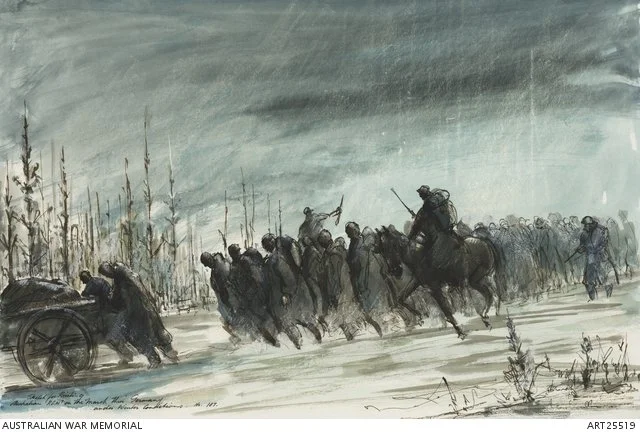
Long March - Australian War Museum
It is January 1945 Toruń, East Poland.
For some days now in the camps, the expectation of a Russian breakthrough was in the air.
Comments from Tom and George’s diaries;
The last four entries in my dad’s diary for this period, I already included in Part Three of his story. I however am repeating them in this final section, in order to highlight the heightening excitement, mixed with some level of trepidation being experienced by the prisoners on the eve of their evacuation;
Tom’s last few diary entries;
January 22; “A day of excitement, the Russians are about here, don’t know what is happening. We can hear the guns. Worked on the saddling half day. In the afternoon worked in the hop(?).”
January 23; “More excitement, the boss and the workers went to dig trenches but came back at the double as their enemy was coming. They have not put in an appearance yet. Got packed to go today but the order was cancelled. We are now about in the front line as far as I can make out. Heard the machine guns today.”
January 24; “Never went to work this morning things seem to be going back to normal but we can still hear the guns very loud. After dinner we were sent back to work as usual, went saddling. The guns are still pretty heavy they are about fifteen miles away. Some people from Lit (Lódź?) packed their wagon tonight they are going in the morning. They are stuck somewhere between Br (Bromberg?) and Nak (Nakto nad Notecia?). 9.15 lull in the firing. One of the lads has just heard machine gun fire. The boss went to get his horses back.”
January 25; “Stayed in bed till about 11 o’clock. The guard came in and told us to pack again. But again it was cancelled and we are still in our working party. They packed the wagon today and there is a rumour that he goes tonight but not anything definite. This waiting is no so good, if something would happen it would be a relief. Can still hear the machine guns.”
George’s diary;
January 17; “Warsaw fell to the Russians and they are pushing towards Thorn (Toruń), about 30 kilometres from Schulitz, (Solec Kujawski) where we are working at present. The bosses are all dashing about watching one another. I think they are frightened the others will make a dash for us. As for ourselves we do not know whether they will march us into Germany or leave us here. If they do the latter I think we will be home a lot sooner. Unless of course they make us fight, in which case we will, most of us, never see England again. They have started to evacuate Thorn (Toruń), the Poles are happy, but those that have signed German are all dead scared.”
Having taken Warsaw the Russian Army continued its advance, moving inexorably west on several fronts. The German Army was being pushed back towards where they came from and at that point decided to evacuate its POW camps. Less than a week after the fall of Warsaw, thousands of prisoners were on the move back west, prodded on by their German and Ukrainian guards, deep into central German territory. They say to prevent their liberation by the approaching Red Army.
George gains his freedom;
I take up George’s story again, as he describes leaving Stalag XXA on the 21st of January in serious winter weather and being marched all the way to Bydgoszcs (Bromberg) where they stayed that night. On the 22nd, weather still foul, temperature well below freezing, then they were away again. The plan was to keep heading west to Nackel, however the Russians were already there so they were ordered to swing north and west and go to Zlatów. It was a bit further and the going on icy roads was tough. That night, 22nd, they slept in a barn. Next day, 23rd, progress was still slow and by the time darkness fell they had not reached Zlatów. Another uncomfortable night in a farmhouse followed. In the morning, the 24th, three of us stayed put and hid in a barn. Luckily our guards did not notice we were missing from the ‘column’. Mind you I think they were having just as hard a time as we were. After we were sure all the guards had gone, we came out of hiding and went to the farmhouse and knocked on the door.
One of the daughters took us to a barn and got us to go up a ladder and hide in the straw, urging us, by putting her finger to her lips in a ‘shush’ sign to be silent. She took the ladder away and left. We stayed there for a few days, during which the young girl brought us what scraps of food the family could spare. It was obvious she was really scared.
Then, on the 28th January 1945, George Wedgbury was free. Not that he was quite ready to believe that immediately. But he was.
It was mid morning when the young girl burst into the barn, running. George thought they were about to be captured again. The girl put the ladder up and shouted for the trio of prisoners to come down. Tears of happiness flooded down her cheeks and she hugged each of them. Russian soldiers entered the barn. We were struck dumb. Then the these giants of men embraced the three of us astounded prisoners and kissed our cheeks. They also were tearful and obviously delighted to see us.
George’s actual words;
‘To suddenly have these great big tough Russian soldiers, armed to the teeth and covered in muck, throwing their arms around us and kissing us on the cheeks was quite a shock I can tell you. But suddenly we realised that after all these years we were free, so were the Poles of course and I suppose the Russians were happy because they knew the war was almost over and they’d be able to go home soon as well; it was a marvellous moment and I will never forget it.’
George then spent the next few weeks of ‘freedom’ moving about Poland, meeting up with Russian Officers, American soldiers and then spending more than two weeks at the YMCA in Lódź. ( including going to the cinema and seeing Judy Garland in one film then Bing Crosby in another ) Then he was on the move again, this time by train to Odessa, where on the 11th March 1945 he boarded a ship named The Duchess of Bedford - section D4 181 Mess Table 161. Some days later, 24th March 1945 they called into Gibraltar and next day they left in an escorted convoy.
George stepped back onto British soil at Dunoon, Scotland, on 30 March 1945, some six years after leaving via Southampton in 1939.
Moving on to Tom’s brother Jim.
Jim got a mention in Part Three of Tom’s war, when he appeared one evening outside the wire of the camp his brother Tom was being held captive.
Jim’s war was quite different from his brother Tom’s. Jim was a regular soldier, Royal Artillery and fought in the African front.
He was captured by Italians on 15th December 1941 at Ghazla, North Africa ( near El Alamein ) and imprisoned near Turin, Italy. Conditions were very bad, food was scarce. When Italy surrendered on September 8th 1943, he simply walked away from the camp.
Sometime in late 1943 or very early 1944, Jim appeared outside the wire of his brother’s work camp. Tom, was summoned by fellow prisoners to go to the wire of the prison camp. Outside were four figures, three Americans and his brother Jim, all in uniform, covered by thick sheepskin jackets. Jim spoke briefly to Tom, urging him never to speak about the encounter, then the four figures melted back into the forest.
In February 1944 he was again captured, this time by Germans, who took him to prison camp XXA Toruń, east Poland and so, for the second time he became a Prisoner of War. Tom had no idea his brother was in the same prison camp as him.
When XXA Toruń was evacuated by the Germans in January 1945 as the Russians approached, the long march started. I do not know which part of the Toruń complex Jim was imprisoned in, or was he in a work camp? Anyway, he was amongst those moved out of the complex and marched west towards Germany.
In the first few days of the ‘Long March’ Jim evaded his guards by hiding behind a wall. He stayed concealed for a few hours before breaking cover and making his way towards Bydgoszcz where he encountered Russian forces. Similar to George’s experience, once the Russians had convinced themselves that Jim was British and not German, they looked after him, including sharing some of their rations. They transported him to Lviv in Ukraine where they passed him over to some American airmen and flew with them to Teheran. Once there he was handed over to the British Consul who had him flown to Cairo.
After hours of questioning, or should I say, interrogation, Jim was flown back to Britain.
Returning to Tom’s struggles.
Back to Tom and his continuing struggles. He had not hidden behind any walls or barns and while George and Jim were heading back to Britain, Tom was still with the rest of his fellow ‘krieges' and being subjected to the full length of the cruel, Long March back to Germany.
Kriegie is a shortened version of Kriegesgefangenen, the German word for prisoner of war. Allied prisoners used the shortened version to describe themselves.
Over a quarter of a million Allied Prisoners of War were held across fifty-five camps and seven hundred subsidiary Arbeitskommandos (work camps). Many situated in Poland and in the case of Tom, Jim and George, north eastern Poland. It is estimated that some 80,000 or so, prisoners were forced to join the gruelling ‘Long March’ trudging along at least three evacuation routes that spanned an area of more than over 500 square miles. As will become clear in what follows, years of inadequate rations had left most men physically unprepared for the evacuation and their few items of clothing offered little protection against the appalling winter conditions.
I will use Tom’s experience to flesh out some of the detail of what being in the ‘Long March’ was like.
On the day Tom and his fellow prisoners, two or three hundred he said, were moved out of the work camp, the snow lay deep, the temperature was minus 25 degrees and the Vistula was frozen over. It was said, although Tom did not witness it, that Russian tanks crossed over it.
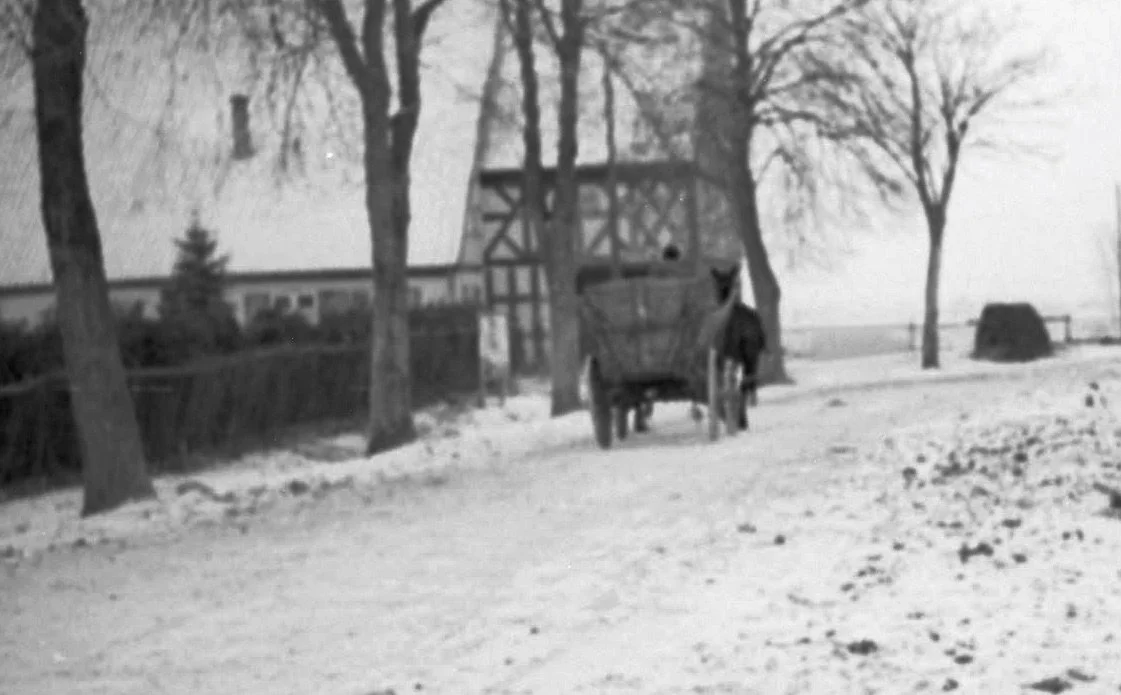
Snow in Toruń
The prisoners wore the clothing they were captured in, which offered little protection against the appalling winter conditions. Tom was lucky enough to still have his army issue trousers, tunic and great coat. He wrapped a few things in the blanket he slept under. Tom was lucky, he was a shoemaker and cobbler before the war and over the years in captivity he had been able to obtain bits of leather from various sources and with it he was able to mend and repair his boots and those of some fellow prisoners. So when he left they were serviceable. Others were not so lucky.
Some prisoners were either too ill or not in a condition to undertake what was about to follow. They were left in the camp. In the days and weeks that followed they were liberated, often by Soviet troops. I suspect some died.
In preparation to leave, each prisoner was issued with a bit of black bread a bit of cheese and I think he said a sausage. Then they were on their way. Tom and his straggling group initially headed north towards Gdańsk (Danzig) and joined up with other groups of prisoners and their guards. The chat amongst the prisoners was that they were going to swing west and get to Nackel. Tom recalled that that plan was abandoned, he heard some guards talking about Russians, things got less orderly and they kept changing direction and going through small villages. The guards seemed more anxious then and kept shouting at them to go quicker. It made little difference. On and on, day after day, the men shuffled along as best they could in rows two, three and sometimes four deep.
The snow was deep and piled up at the sides of the road, when they were on roads. It was even worse for the men at the back of the column as up front the snow was being trampled into the ground and freezing into ridged ice. It was so cold that icicles clung to their unshaven faces. It was difficult and exhausting. Tom said that it was just as difficult for the guards.
And on they trudged, day after day, meandering right and left but always moving further west. The weather was getting slightly less cold, slowly melting the snow and ice. Then they were having to contend with wet sticking slush and soaking, cold feet. Tom talked about being covered in lice that crawled through his clothing. He said they were all stinking and wore the same clothes for weeks.
Food was another problem, they got little to eat. A lump of bread most days, then maybe a some potatoes and other days a cup of thin runny soup. Tom called that gruel. In short they were starving, losing weight and getting weaker. Drinking water was also in short supply, and just like their early days of captivity in France, they were forced to drink from ditches, streams, anywhere they found water. Dysentery spread but there was no medical treatment. They had no choice but to relieve themselves as quickly as they could at the side of the road. The guards showed no mercy and quickly forced them back into line at gunpoint. Despite all this they were managing to cover as much as fifteen to twenty miles a day. And still they were forced to speed up, go faster.
Some of them were so weak and unwell that they collapsed at the side of the road. Other prisoners would try to help and get their fallen colleagues to their feet. They were not always successful and would have to leave them to their fate. In many cases, to die and on occasion, get shot.
Towards the end of their ordeal, Tom and a fellow prisoner were caught digging up turnips in a field. The guard who caught them gave them an unmerciful beating with the butt of his rifle and kicked the living daylights out of both of them for good measure. While my dad was badly hurt and carried the scars on his forehead and leg till the day he died, his fellow prisoner was not so lucky and he died soon after his beating.
Much of Tom’s ‘Long March’ ordeals he took to his grave, however he did let us into his nightmares sometimes.
One incident Tom did relate involved preparing and eating what he described as a ‘Cordon Bleu’ meal. They were somewhere in Germany as Tom recalled, resting beside a huge railway siding. His group, half a dozen of them, were sitting on the steps of a railway building and had just been issued with their meal for the day, the usual lump of black bread and on this occasion, a cup of thin gruel. One of their number had been behind the building relieving himself. When he returned he was carrying a metal bucket that contained the remains of two fish heads, bones and tail. Also in the bucket was a collection of discarded vegetables, potato skins, some floppy green leaves and pairings from a turnip.
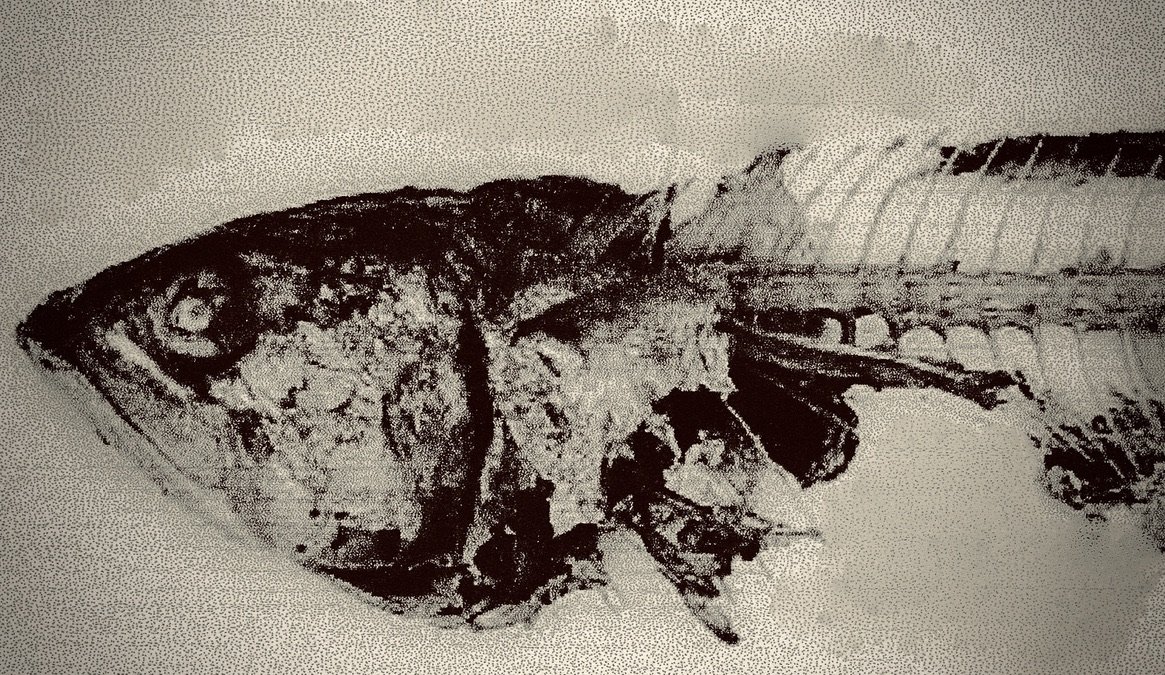
Fish head and bones
They emptied the bucket, cleaned it as best they could, then refilled it again with the ’Brock’ as Tom called it. They added the cups of gruel they had just been issued with. The bucket was placed on top of splinters of wood that was, by some means, lit and the cooking commenced. Thus was the ‘Cordon Bleu’ created. As they ‘tucked in’ a short while later they heard the sound of approaching aircraft and soon the sky was black with what he thought were Boeing B-17 Flying Fortress long range bombers. Whatever they were made no difference, they railway siding was obliterated while Tom, the other prisoners and their guards, ran for cover in a nearby forest. When it was all over, not only had the sidings been destroyed but so had the remains of their tasty soup. Bloody Americans was the cry.
When the raid was over, they were on the road again, on their seemingly endless and futile march west.
Sometime in mid March, somewhere to the north of Hamburg their guard spirited away, leaving the prisoners on their own. Soon afterward American troops appeared and Tom became a free man.
Tom and his fellow prisoners of war had been on the road for two months or more. The distance from Toruń to Hamburg by today’s road network is 435 miles. Tom and his fellow prisoners were not on today’s road system. They meandered ‘hither and yon’ to avoid the ever present Russian troop advance and because of that, probably walked much further.
Many died and found a different freedom. Many suffered for years after their ordeal.
On his release, one of Tom’s first tasks was to approach an American officer and ask if he could borrow his pistol. The officer asked one question; ‘what are you going to do with it’. Reply; ‘find the red headed guard who beat me up and killed my friend’. The Officer simply nodded and uttered, ‘OK’ and handed his pistol to Tom.
Tom never did find the red headed guard, nor as it turned out, did he ever find the American officer.
A few days later Tom got the first aeroplane trip of his life when he was flown back to Britain in a military flight.
He still was in possession of the American Officer’s pistol. A bit of war memorabilia that stayed in our house for a few years. Then it didn’t. I have no idea what happed to it.
Tom did remark once that, while the march into captivity was bad, the march home, as he called it, was a hundred times worse.
Once home Tom went to the bank to collect his military back pay, a meagre one hundred and odd pounds. He asked for the complete amount and when the teller suggested it might be foolish to carry that amount, Tom smiled and put his hand into his pocket and felt for the pistol. He then took all he was owed.
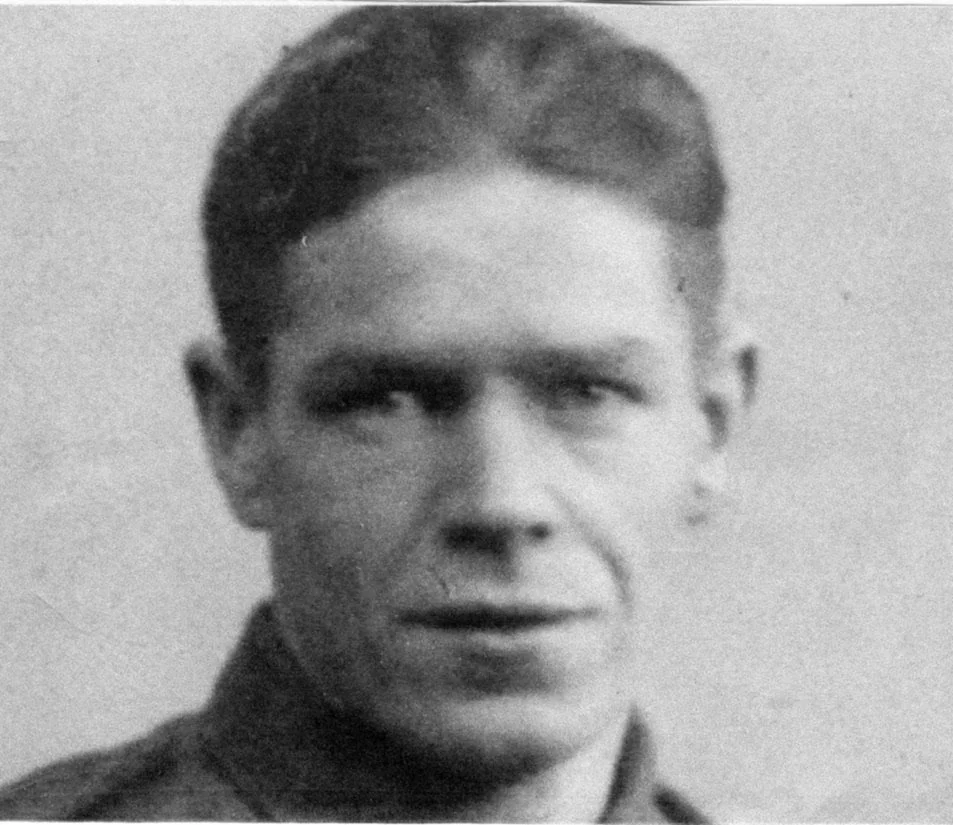
Tom’s army picture.
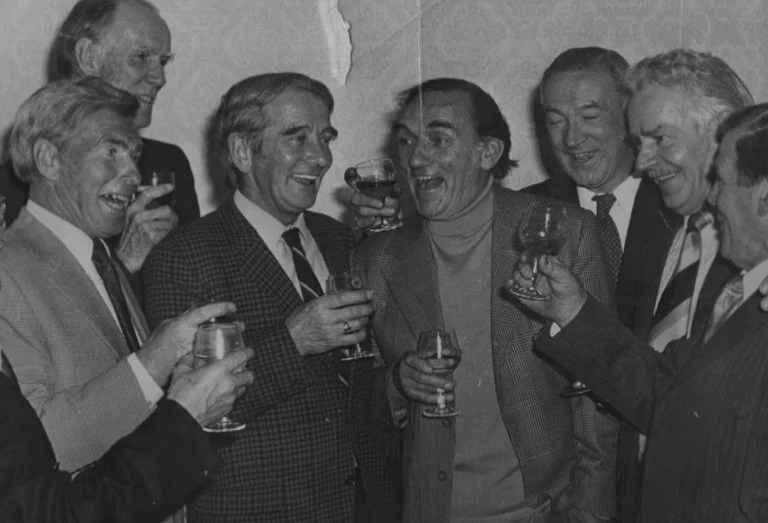
Reunion of POW’s sometime in the 1960’s. Sam Kydd in middle, Tom second from right with striped tie.
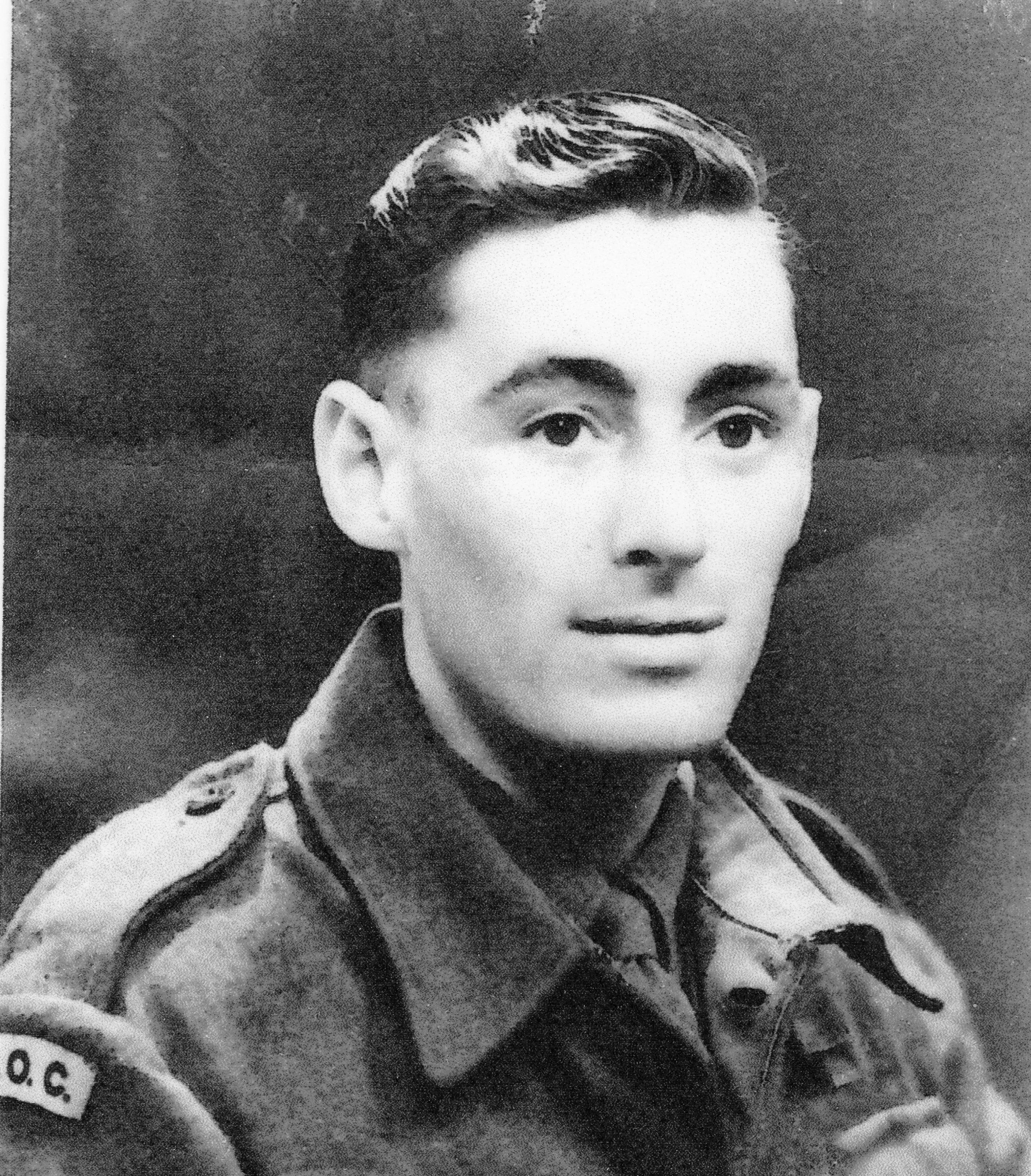
George Wedgbury
George when back to his home in Coventry, amongst his loving family lived a full and positive life.
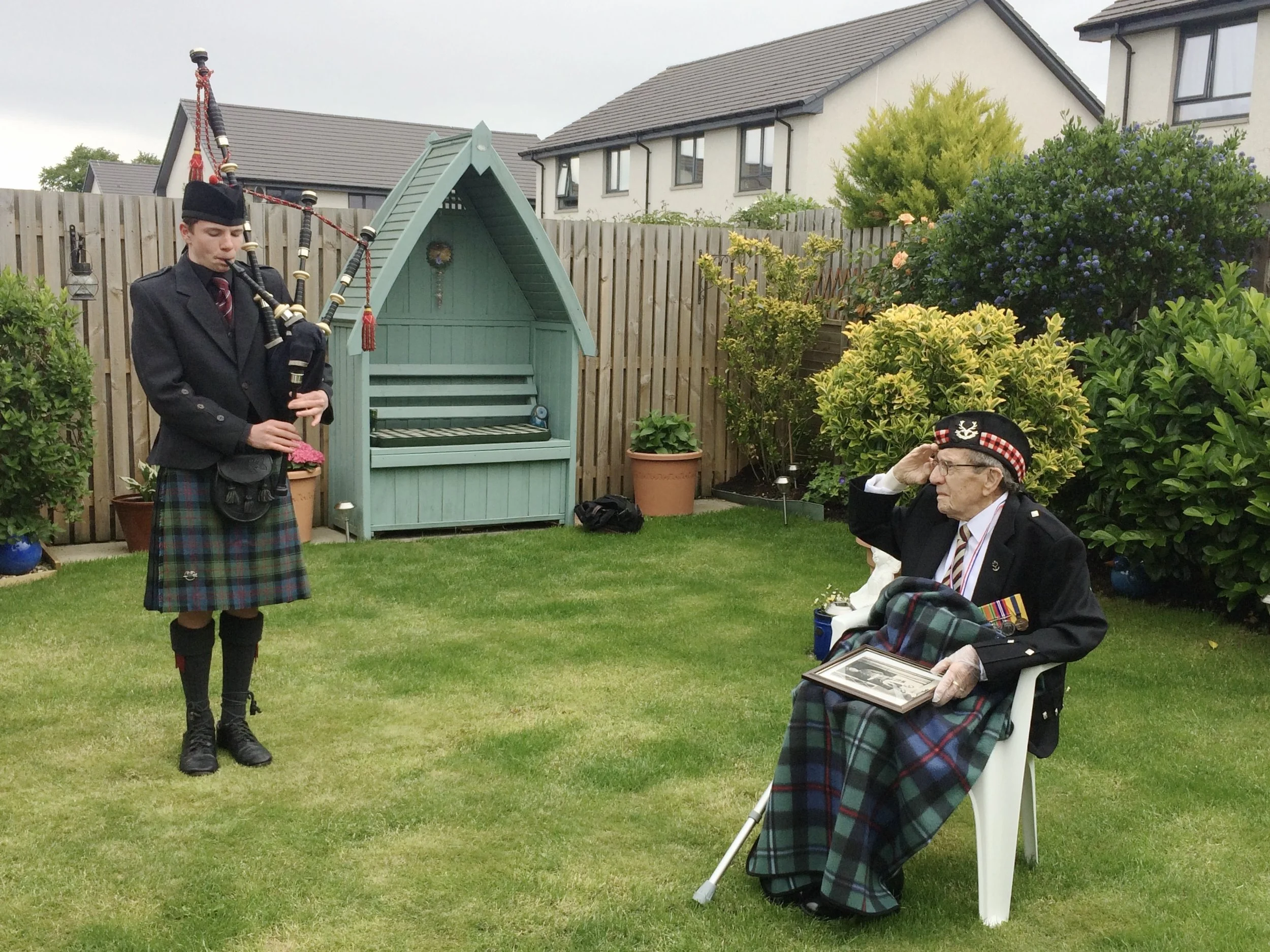
Don Smith and piper Murray McNeish ( Tom’s great grand son )on 80th Anniversary of St Valery en Caux
Don lived out his last years in Forres with his lovely wife Helen. He died in 2021, aged 100.
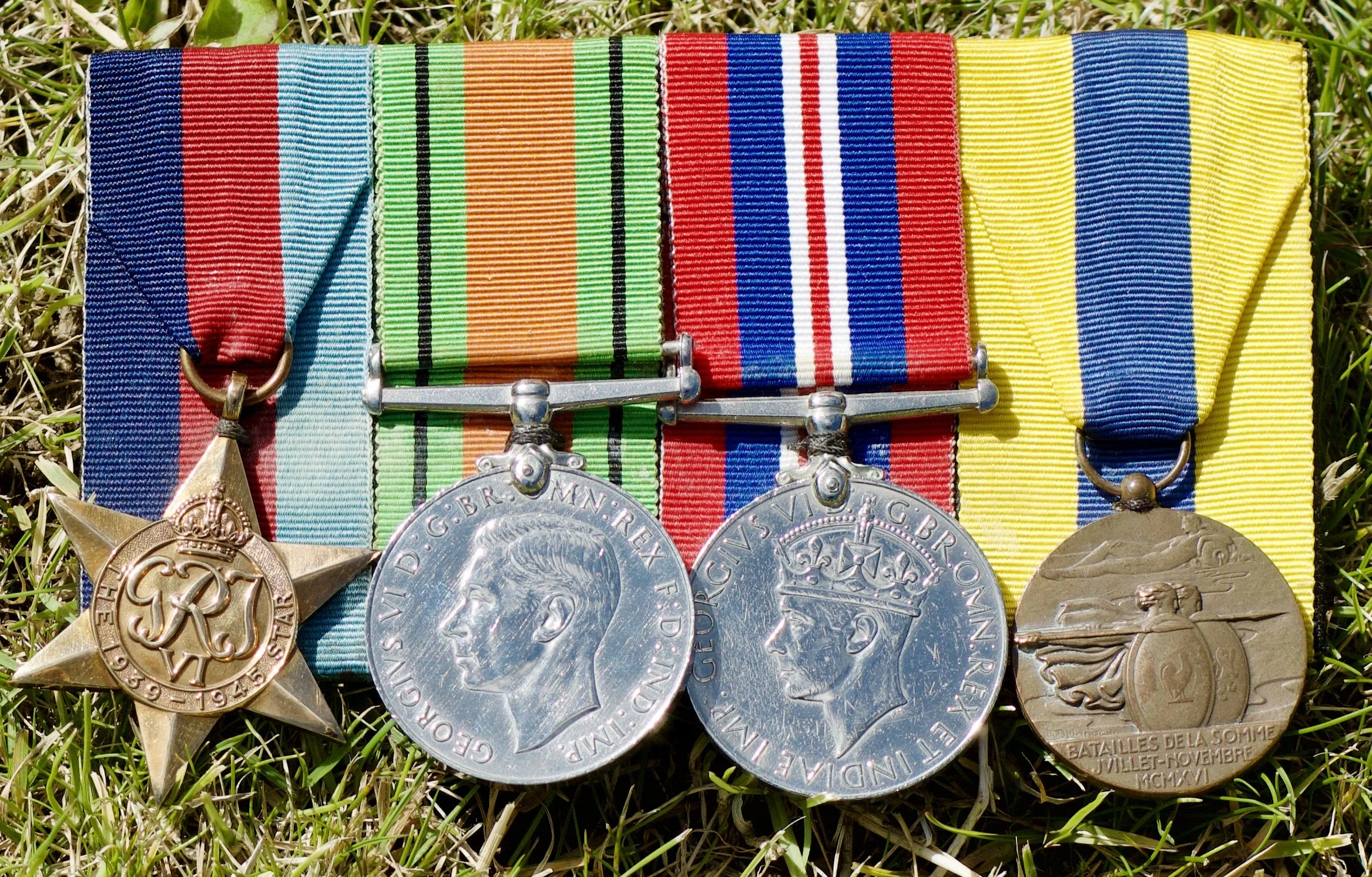
Don’s medals - on the right - the Somme Medal - presented to all of the 51st HD who fought down the Somme in 1940.
Tom died in 1974, aged 54 years. When he died, one year after my mum, he did not own a car, had no savings, and was, in terms of todays definition, in poverty, living in a council house in one of the poorest estates in Glenrothes.
But he was not in poverty, he and mum had a loving relationship, he had five years experience of how to survive and understand the value of things and the value of life. Oh, and he had his fishing rod. He was the bravest person I ever knew. His legacy to my brother and I was simple; be ethical, be fair, work hard, do not judge others, be honest and if you cannot afford it, learn to live without it.
His experience scarred him but did not bow him. He was a calm, positive, non judgemental, decent human being who would not countenance unfairness, he was a solution focused rationalist. One of his often used phrases was;
‘What is the worst that can happen, are they going to take you out and shoot you?’
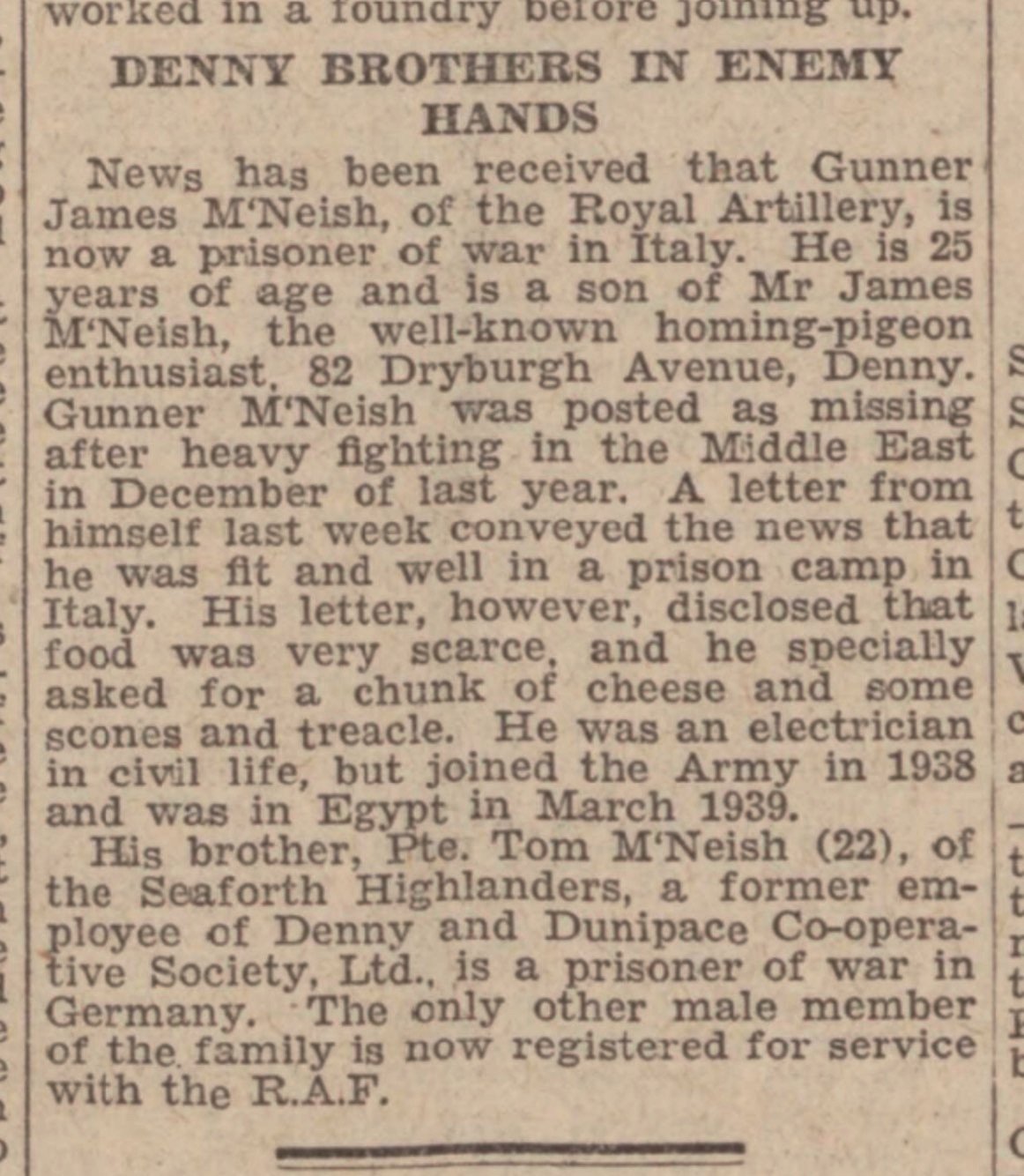
Newspaper clipping of McNeish brothers.
The George Wedgbury content was from his memoirs, as edited by Brian Currie, who kindly allowed me to access and use sections of his work in order to create these posts. I acknowledge and thank Brian.
This website - thefearnoracle.com - is not a commercial venture. I do not seek, or in fact receive, any form of payment. Its whole purpose is in two parts; my pleasure at researching, writing and compiling the content and perhaps more importantly, well to me anyway, to leave memories for my family and friends. If any of them ever get around to reading it.
I also acknowledge Richard McNeish, San Carlos, Texas, for his expertise in helping me set up the website.
For further information on this part of World War Two, I commend a documentary entitled: “Dunkirk: the forgotten heroes”, produced by Craig McAlpine.
Two quotes from Craig’s research are quite revealing; “This is the BBC, you know the old toffee nosed way of talking, ‘The British Expeditionary Force has been successfully evacuated from Dunkirk.’ I thought, what a load of bollocks.” Gordon Barber, Royal Horse Artillery, 51st Highland Division.
A comment by one French General on the British Expeditionary Force’s arrival in France at the beginning of 1940; ‘Sheer madness, we have gone to war with a 1918 army against a German army of 1940!’
I leave the final comments to my three heroes, my latter day Paladins, Tom, George and Don;
Tom : “When old men in power, quarrel, they send young men who have not quarrelled to kill each other. That is war.”
George : Early in the conflict, before being captured; “It was a beautiful morning, not a day one should have to die, but as it turned out, quite a few did just that.”
Some five and a half years later, on realising he was free; “To suddenly have these great big tough Russian soldiers, armed to the teeth and covered in muck, throwing their arms round us and kissing us on the cheeks was quite a shock. But suddenly we realised, after all these years we were free.”
Don : “My experiences in the war and as a prisoner of war, strengthened me and taught me not to look at my image in the mirror, but look beyond it.”
Thank you all who read this account to the end.