Stories From World War Two - Part Two; Boots, Barges and Bouregh Waggons.
And so began nearly five years of hell for Tom, George and thousands more.
The Journey to Captivity, or as I have titled it; Boots, Barges and Bouregh Waggons, will mainly be revealed through the experiences and thoughts of Tom and George. Otherwise I will make use of the ‘third party’.
(Don, who had been badly wounded in the run up to being captured, was being treated in a German Military hospital during this period.)
I should explain Bouregh Waggons at this juncture: The word Bouregh is old Scots ( Related to Scots Gaelic, Bourach ) and means; a pile of something or a cluster or crowd, of people. It also links to disorder. My Dad knew a smattering of Gaelic and more old Scots. When you read how the prisoners were transported over the railway network, it may help you understand why he coined that name for the wagons.
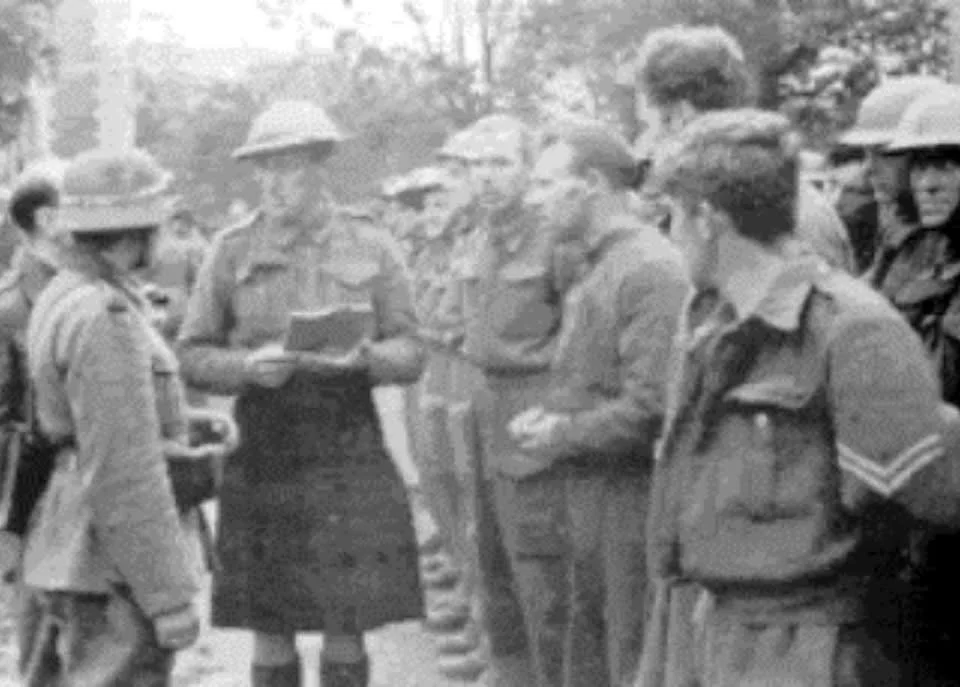
prisoners details being taken.
They had been in retreat for weeks and had seen friends killed beside them, often their bodies left where they fell. They had been running on empty for the last few days, physically and emotionally. Now it was all over.
But it was not all over.
To quote George; “What followed was a month of hell that I will never forget as long as I live. We were herded up like animals, in our thousands, into an open area surrounded by gleeful guards, armed with rifles and supported by tanks. We were prisoners of war”.
Tom said that he could not explain how he felt deep down. He, and he suspected, most of his colleagues, felt ashamed and angry. The question he asked; ‘What was it all for, why have so many young men died?’
Then, like everybody else, too exhausted to think about what was ahead he just lay in the warm French sun and slept.
During the afternoon of the second day, trucks arrived with food. George recalled being forced to stand in a queue for three hours, waiting for a bit of bread, lard and red herring; ‘I hid a bit of my bread in my boot to stop it being stolen. My boots smelled horrible after all that marching. Eating the herring made us thirsty. Getting water meant more waiting and we had to stand in another queue for two hours waiting to fill an old bottle we had found. About six the following morning we were awakened by the guards shouting and waving their rifles. “Like sheep being herded,” someone muttered.’
‘Then the hell really started; the journey to captivity. Tom had no idea where he was going or how long it would take.’
A murmur went around that they were being taken away from the town to a quiet place, to be shot. A long procession of bedraggled soldiers, like a caravan of outcasts, some shuffling, some marching, more than ten thousand of them headed off across France. Through areas they had so recently battled through and sometimes during those battles actually thinking they were winning.
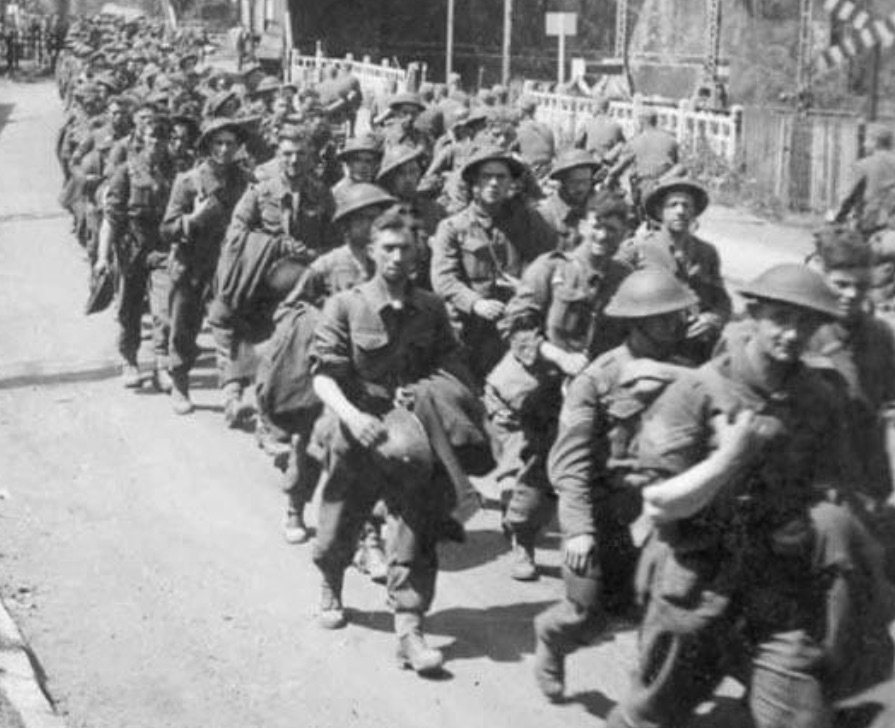
a procession of 51st HD prisoners - image from Imperial War Museum
Tom, many years later, now home and sitting in front of a warming coal fire in our prefab near Bonnybridge, surrounded by his adoring family; his wife Cath and his two young sons, spoke about the illusion of war, as he put it.
“I was a foot soldier and from hour to hour my platoon or group would reposition and take stock, moving forward when we could. We rained bullets and mortars onto the enemy when we got the chance and took cover when they replied. But here is the reality of war for the front line soldier, the focus is on the here and now; the next ridge, the bridge, the wooded area in front of us. There were times we thought we were winning. Why? Because in these early days we did force them back occasionally. In the reality of war, we could only see the tiny fleck of paint we had daubed. The canvas was huge and we could not see it all. We were not aware of the big picture and did not know our position was hopeless. We were never told that we were on our own and that Dunkirk had already happened.”
Their route through France took them from the coast at St Valery en Caux, north of Paris and south of Lille, passing through towns and villages, such as; Fourges les Aux, Ameins, St Pol-sur-Ternoise and more till, towards the end of June, they reached Seclin near the Belgian border. They were walking about 35 to 40 kilometres (upward of 20 miles or so) each day. George found it really hard; ‘The longest marches I had ever done. The infantrymen had been marching all over France and Belgium and were probably more used to it than me, who had been driving a Bren gun carrier most of the time.’
Sleeping was a simple process. Lie down under the stars, no huts, no tents. If they stopped for the night near a farm with a barn, that was luxury. Certainly for those that managed to get inside. It was summer in France and really hot. They were always thirsty and as their captors did not supply them water during the day they were reduced to getting it from ditches and stagnant pools, scooping it into their tin helmets. Such was the desperation for drinking water that these moments often resulted in a mad rush, with fights often breaking out.
George writes in his memoir;
‘Every night when we stopped, it was always the same, we queued ages for the usual watery soup and hard, black bread. Sometimes, if we were lucky, it would be beans. I had an old ‘Gold Flake’ tobacco tin and I would put my beans in it. If I managed to fill it I would think myself lucky. In the mornings, before we set out we would get another bit of bread, not much more than a mouthful. Then we were off, march, march, march, all day long, sweating and footsore. Sometimes we would break ranks and go into fields beside the road to get water or perhaps potatoes. The guards would threaten us with their rifles. A lot of prisoners were shot’.
During the first few days most of the villages they passed were deserted. It was not until the ‘caravan’ was in northern France, near Lille, not far from the Belgian border, that it encountered locals. Many came out onto the streets and threw tobacco and bread for the captured soldiers. Sometimes fights again broke out amongst the prisoners. They were starving and if they didn’t fight they got nothing.
Towards the end of June they exit France and enter Belgium, still travelling roughly north, north east, passing through small towns, such as Tournai and Aalst, and going between Gent and Brussels, before swinging north through Lokerin and into the Netherlands, heading for the railhead of Hulst.
Whilst travelling through the northern villages in France and through the Netherlands, it was not uncommon for citizens to place buckets of water at the side of the road for the passing prisoners and pass them food and cigarettes. Neither was it uncommon for these same buckets to be kicked over by the guards.
At Hulst, they were loaded onto open railway wagons and taken a little further north to Valsoorden for the next stage of their hellish journey into captivity. That short rail journey to Valsoorden, a small shipping port on the south bank of Westerschelde, where the River Schelde disgorges into the North Sea, allowed them to rest their weary bodies for a wee while. Another advantage, if one can claim any advantages, was that the train travelled slowly, allowing the brave Dutch citizens to throw cigarettes and food to them.
Both Tom and George had nothing but praise for the villagers of northern France and the Netherlands, or the Hollanders, as George referred to them. Dad, who came from a coal mining family, referring to their reception in northern France said; ‘These were the inhabitants of coal mining villages and I shall never forget their kindness’. George had this to say; ‘When we got into Belgium the people took no notice of us, except as freaks. In Holland, they showered us with all they had to give. God bless the Hollanders.’
The forced marching was all but over, but what followed was going to prove every bit as demanding.
At Valsoorden they were crowded into the closed holds of huge river barges and for two full days travelled down the River Rhine through Germany to Kolbenz, where they left the Rhine and turned into the River Mosel for the last bit of their ‘river cruise’ to Trier, apparently, the oldest city in Germany. Their two day barge trip passed the cities of Bonn and Cologne and lovely scenery, however their only opportunity of sightseeing came when a prisoner had to carry out a toilet function, performed whilst precariously balancing over the side of the barge. Any prisoner unfortunate enough to fall overboard, and some did, was shot.
barge
Trier had a temporary prison that served as a staging post for prisoners on their way to permanent camps further east. There was also one in Wesel, just north of Cologne and another near Brussels. Dad and George were housed at Trier.
At Trier the prisoners were herded from the barges and marched through the city streets to the gaol, a scanty compound surrounded by vicious barbed wire and, according to Dad, just as vicious guards. When being marched through Trier earlier, the streets thronged with German citizens who jeered, spat and when they got the chance, kicked out at prisoners.
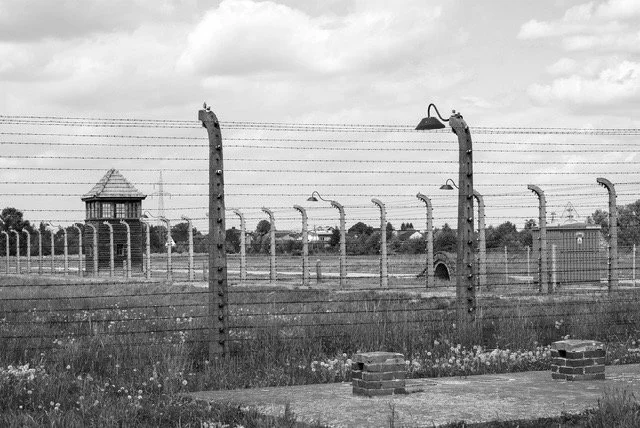
temporary camp - photo by Marsjo from Pixabay
They would spend a week there while the next stage of their journey was sorted out, the final stage of the journey to their respective prison camps. I will use a combination of George and Tom’s memories to describe that last part of the journey;
The train was made up of cattle wagons, each, interestingly, had the words, 8 horses and 40 men stencilled on the side. There were no horses or cattle, but there were sixty men and sometimes more crammed into each wagon. The guards shoved everybody in, slammed the doors shut and padlocked them, not to be opened again until the journey was over. In our case, the east of Poland, three days later. The only ventilation was a small, one foot square window at one end, cross crossed with barbed wire. There was no room sit or even squat. It was standing room only for the next three days, with no respite.
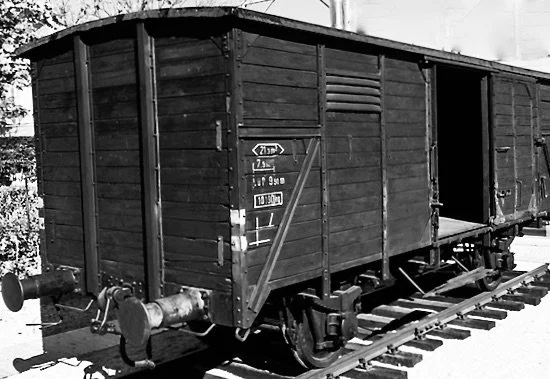
Cattle Truck or Tom’s alternative name ; Bouregh Waggon
With the accumulation of a month of fierce fighting, then capture, forced marches, barge voyage, their humiliation in Trier, coupled with a lack of meaningful food throughout all of that, the men were nearing the limits of their endurance. This wagon ride would be the final lap of that journey, but for some, that finishing line would never be reached.
The men endured those three days of standing with no food or water, hot by day and freezing by night. If they thought the toilet function was bad on the barge, now it was worse. No toilet facilities, not even room to squat or move. Soon the air in the wagons reeked with a pungent smell, causing nausea and vomiting. But still the train kept on and the doors stayed firmly locked. Some prisoners suffered the agonies of claustrophobia, some terrible cramps and dysentry. Some died on their feet, propped up by the living, eventually lowered to the floor amongst stinking excreta and urine and trodden on by shocked colleagues with nowhere else to put their feet. Those that got to lie down were the dead.
George; “If you have ever wondered what hell was like, you could double it and still not come close to what it was like on that train. How any of us ever survived I will never know. The whole journey from St Valery to Poland was hell, but being on that train………!”
And now they had reached their home for the next four and a half years, in the case of Thomas Barbour McNeish, Stammlager XXA, Toruń, east Poland, Room 32.
(Stalag is a contraction of Stammlager which in turn is the short version of Kriegsgefangenen-Mannschaftsstammlager, which means ‘war prisoner’ ‘enlisted’ ‘main camp’. Stalag therefore meaning, ‘main camp’.)
All over Germany and Poland members of the defeated 51st were settling in for the next phase of their life in captivity.
I exit part two of my dad’s war with a document entitled:
United Nations War Crimes Commission dated 16/6/1944
United Kingdom charges against GERMAN war criminals
Charge No. UK - G/B. 29 - On or about 12th June 1940
It then refers to the route they were marched (as referred to in Tom and George’s story)
Citing : murder, ill treatment, breaches of several articles of the Geneva Convention 1929,
again citing murder and or manslaughter, neglect and more.
It finishes with a short Statement of Facts;
‘Prisoners of war were treated with great harshness by their guards. They were over-marched and fired upon when they fell out. Rations were inadequate and they had to rely on the generosity of inhabitant’s for food. When it was accepted, the Germans fired at their legs. There was no accommodation provided and no protection from the weather when halted for the night.’
I have tried, unsuccessfully, to find an outcome to said breaches.
If anyone can enlighten me, I will be grateful.
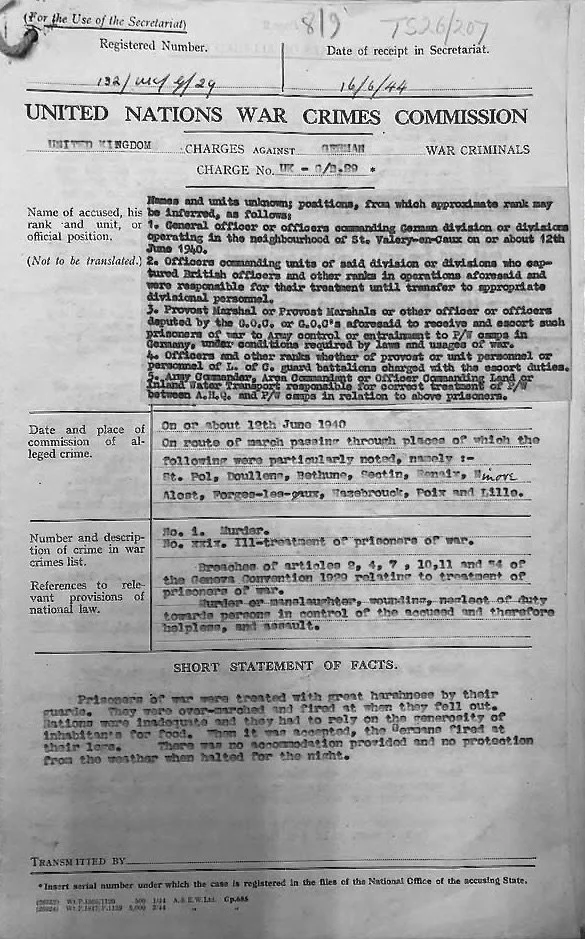
war crimes document