Stories From World War Two - Part Three; Existing in a Stalag
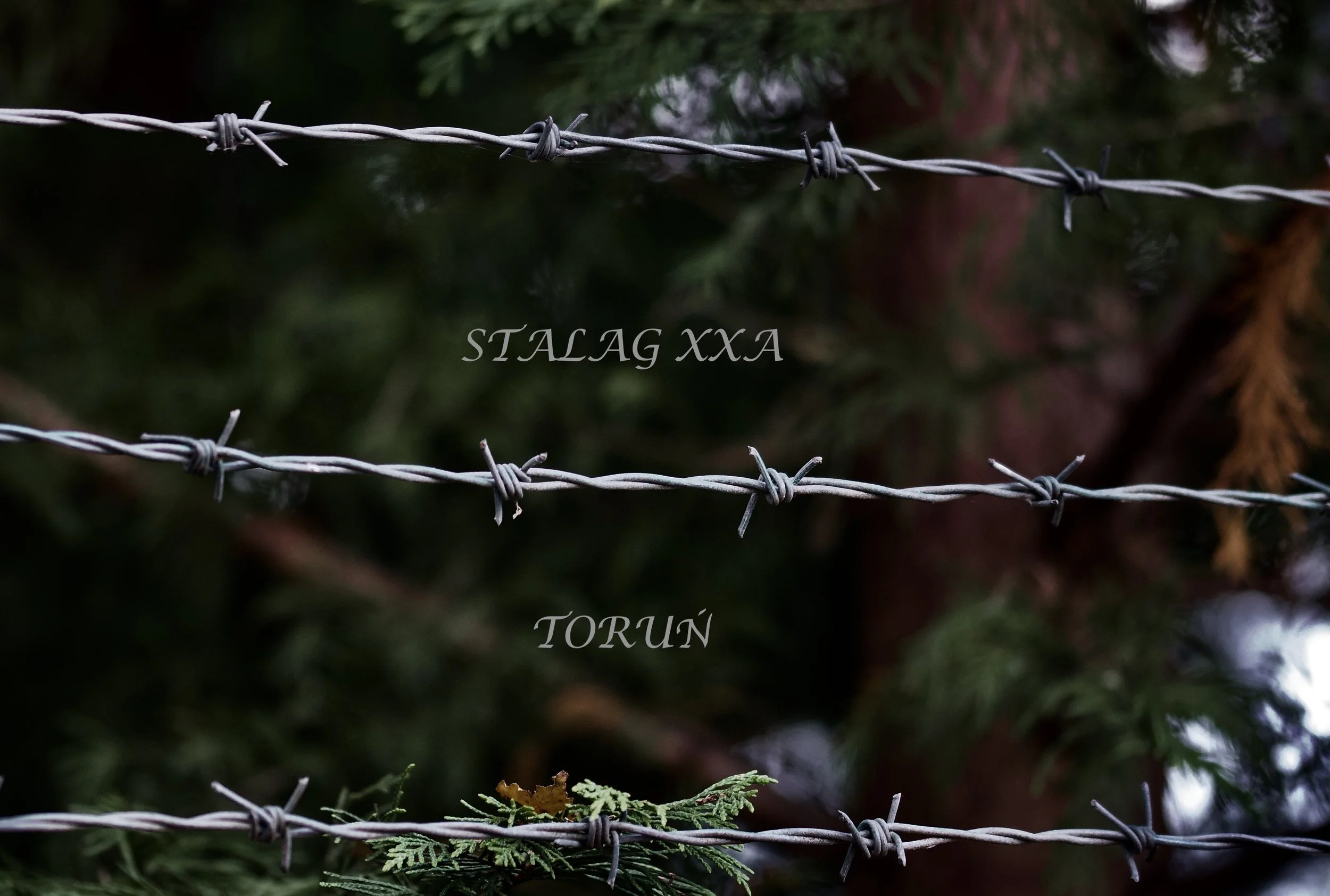
XXA Wire, Toruń
The third part of Stories From World War Two will concentrate on life within a German Prison Camp. For the most part I will confine that to Stalag XXA, Toruń, Poland, where George and Tom spent more than four years of their young lives. Tom, my dad, was twenty years of age when he arrived at Stalag XXA.
Don’s journey to incarceration had taken a different route from that of Tom and George and the majority of the captured 51st HD. Due to the severity of Don’s wounds, received at the time of his capture, he was taken for treatment to the Bégin Military hospital, at Saint Mandé in the Val-de-Marne, outskirts of Paris. His treatment took a few months and on 13 December 1940 he was discharged from hospital and handed over to the military authorities for removal to a prison camp.
For most of his time as a prisoner of war, Don was imprisoned at Stalag VIII-B, later renumbered Stalag-344, located near the village of Lamsdorf in Silesia. It was annexed by Prussia in 1871, and formed part of Germany at the commencement of World War 2. It was used to imprison prisoners of war during World War 1 and also during the Franco - Prussian War of 1870-71.
There were many thousands of Prisoners of War imprisoned in camps over Germany and Poland. There will therefore be thousands of prisoner’s experiences. I am sure that many will be similar and others markedly different.
What follows therefore is directly from the mouths and writings of only three such prisoners, Don, George and Tom. I make no attempt to compare their experiences with any other Prison of War. I have not a lot of information about Don’s prison experience, other than one really interesting story that I will get to in due course. So don’t go away. Most of what follows will be taken up with the experiences of Tom and George at Fort Xlll (Stalag XXA), Toruń (Thorn - German). It is on the Vistula River in north east Poland, about 100 miles south of Gdańsk (Danzig - German) and just over 150 or so miles west of Russia.
The Thorn (Toruń) prison camp was a sub-camp of the concentration camp at Sztutowic. It was built between 1882 and 1885, as part of the Prussian defence network around Toruń. From 1941 it served as an internment camp for Polish soldiers. Stalag XXA was enlarged in 1941. In reality it consisted of a number of defensive forts; Fort Xl Stafana Batorego, Fort Xll Wladyslawa Jagielty, Fort Xlll Karola Kniaziewicza, Fort XlV ( the hospital) Jozefa Dwernickiego, Fort XV Jaroslwaw Dąbrowskiego, (it held French prisoners), Fort XVl Kolejowy or Railway and Fort Xvll Michala Zymierskiego - all situated on the left bank of the Vistula. By then it was universally known as Stalag XXA and its original designation, 357 was transferred to Oerbke near Fallingbostel.
Stalag XXB at Marinburg, now Malbork, some 120 kilometres further north and Stalag XXA were regarded, for ‘administrative’ purposes, the same complex.
Stalag XXC, near Glinki, was built to hold Russian prisoners.
Over 60,000 prisoners moved through the Stalag XXA complex over a five year period. Those who died in Stalag XXA were buried in the garrison military cemetery - except Russians who were buried in a Mass Grave in the forest near Stalag 312, between Glinki and Cierpice. About 14,000 are buried there.
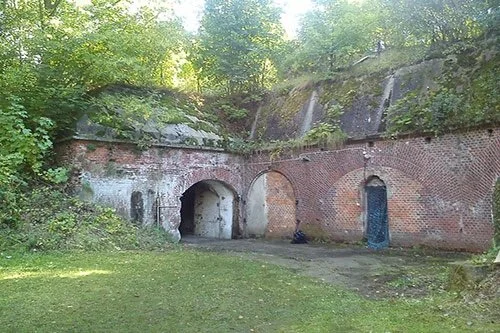
Fort Xlll, Toruń
Living conditions there were dire and cruel. Prisoners endured extreme hardship, not helped by the overcrowding and poor sanitation. It is recorded that many suffered from various illnesses, including malnutrition, dysentery and tuberculosis, some dying as a result. Many prisoners also experienced mental health issues. During Stalag XXA’s relatively short history, from 1939 to 1945, it housed thousands of prisoners from various countries, including Britain, Poland, France, Australia and the Soviet Union.
Back to George and Tom’s arrival in Toruń, Poland.
After the hellish transport experiences, particularly the three torturous days locked and standing in a cramped railway waggon, they eventually arrived at their home for the next four and a half years. When the waggon doors were opened, many had to be assisted out. They were stinking and covered in lice. The dead were dragged out and laid beside the railway line. Tom did not see them again and never knew what happened to them.
The living were escorted into an area surrounded by barbed wire (Camp 11b), where registration took place. Each prisoner was given a form and instructed to write their name, army number, rank, birth date, home address and civilian occupation. After that they were given a prison number and photographed, holding that number over their chest. They were then moved to another area where different guards interrogated them about their units, the equipment they had used, where they had been and details like that.
All prisoners were then issued with a metal identification tag. It was perforated across the centre with prisoner number and camp identification on both half’s. In the event of a prisoner dying, the tag would be broken in half along the perforations. One half stayed with the body while the other half was used to register and identify the deceased to the neutral Swiss Protecting Power and then sent home to the next of kin.
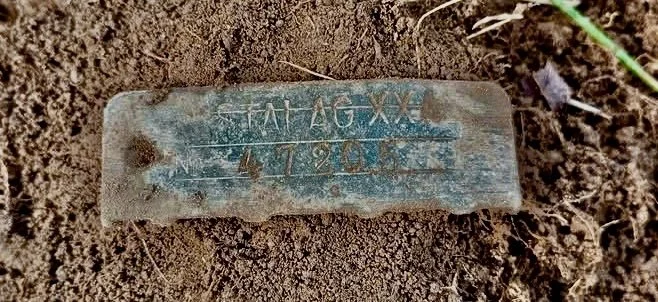
pow metal identification tag
Tom described these Germans as; ‘real Nazis’, officious and brutal in the way they spoke to and treated the prisoners. Tom was called a ‘verfluchtan’ highlander. Not that he knew what that meant then. He would soon learn as it was shouted at him often during his time in captivity. He hated it when they referred to him as an ‘Englander.’
George had a more sinister time during his interrogation. It probably lasted a bit longer because George was involved with armoured vehicles and armaments. The worst part was when his name was repeated to him. They pronounced Wedgbury as, ’Vegburg’ and asked if he was Jewish. He said no, they seemed to believe him, but George was not sure and worried about that encounter for a long time after that.
The next part of the ‘induction’ involved delousing. Every last one of them was crawling with lice. The treatment involved taking a long, hot shower, scrubbing all over with coarse, green, German soap and having all hair shaved from their bodies. While that was going on, all their clothing was being baked in large ovens to kill the lice. There was a problem to that approach, while the live lice were killed off, the eggs were not and hatched out a few days later. If the lice found broken skin or fresh scars, they would concentrate in these areas and cause bad sores. That meant that prisoners had be deloused regularly. The sores, when healed, left bluish scarring on the skin. Tom had such marks on his legs for the rest of his life. I think George had the same reminder.
After that they were split up and taken to different locations within the Toruń complex. George started in Fort Xlll and Tom was initially billeted in Room 32.
It seems that part of Stalag XXA was reserved for prisoners who had been identified as having skills that would be useful for work their captors required to be carried out. George was a driver and had mechanical skills, hence his selection for that placement.
Tom was a shoemaker and worked with leather. He was identified therefore as ideal for being sent out to do agricultural and or forestry work. There is no reference to him having been in any other camps. From my recollection of his stories of that time however, he certainly made references to punishment camps and ‘work’ camps. Perhaps they were all part of the same camp?
Tom and George both kept diaries during their confinement. Neither however covered all their time under lock and key. I assume that was because the camps were occasionally searched and diaries were removed. Tom suggested that their captors examined the content for intelligence gathering.
The Red Cross and St John war organisation based at St James’s Palace, London SW1, published a regular document entitled, The Prisoner of War. It was distributed, free of charge, to the next of kin of British Prisoners of War. It acted in some way as a diary of events for those back home.
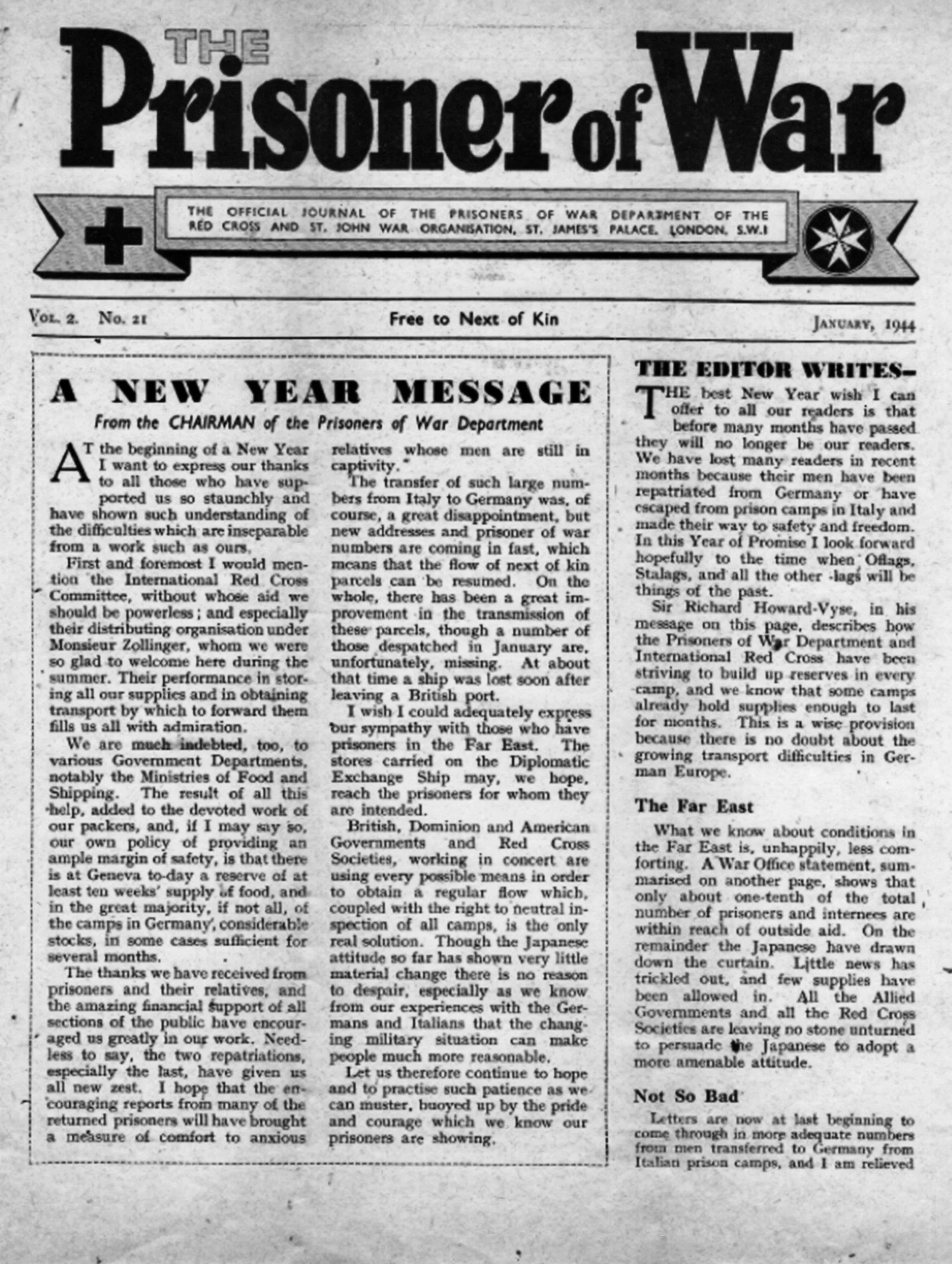
The Prisoner of War publication January 1944
A Prisoner of War’s right to pursue intellectual activities is enshrined in international humanitarian law (IHL) derived from the Geneva Convention relative to the Treatment of Prisoners of War 1929 (Art. 17). It also enshrines the encouragement of intellectual, educational and recreational pursuits, sports and more amongst prisoners, including providing adequate premises and equipment. Many of the entries in George and Tom’s diaries were about such activities. George’s diary content mainly covers the first three years of his confinement. Tom’s on the other hand, whilst covering a short part of his earlier confinement, also covered, in a bit more detail, the last few weeks of life in the Stalag leading up to being moved out and force marched west back into Germany in the winter of January 1945. The “Death March”.
I will therefore, to give a wee flavour of their routine activities whilst incarcerated, select a few snatches from both their diaries. Much of their entries are quite similar, covering benign, day to day life in captivity. As mentioned earlier, the camp had a bad reputation and I assume, both suffered some level of hardship and indignity during their stay. Their diaries stay silent on such issues.
George’s main passion seems to have been football ( some may call that activity, soccer ), his diary entries reflect that. During 1942 he played a lot for a camp team called Falkirk. Played 8, lost 1 drew 1 and won 6. 24 goals for 9 against. Falkirk won the league. Other teams in the league; London Midland Scottish, St Bernards, Millwall and Brentford. I assume the team names were influenced by prisoners from these areas. My particular interest in his Falkirk reference is that I was born there and have supported them all my life. Now is that not a bit of a coincidence?
George and my dad read a lot of books during their time at Toruń. I think books were supplied by the Red Cross under the banner; intellectual activities. Here are just a few of the titles that satisfied that intellectual requirement; ‘Pawned’ by Frank Pacard, ‘ Pererio of Cherry Trees,’ ‘Roaring up Trail’ by Zane Grey, ‘The Eyes of Elmyn,’‘Hash Knife Outfit,’ ‘Opium Clipper’ and finally on 9th September 1942, George, no doubt taking advantage of the intellectual part of his prisoner’s rights, spelled out in Article 17 of the Geneva Convention, engaged in reading the ‘Pickwick Papers.’
Meanwhile Tom spent some of his ‘recreation’ time playing cards, usually Stop Patience or Whist. He also played a bit of football, but his main passion was boxing. There is also the occasional reference to him indulging in his actual trade when he made leather belts for some prisoners and mended the boots of others.
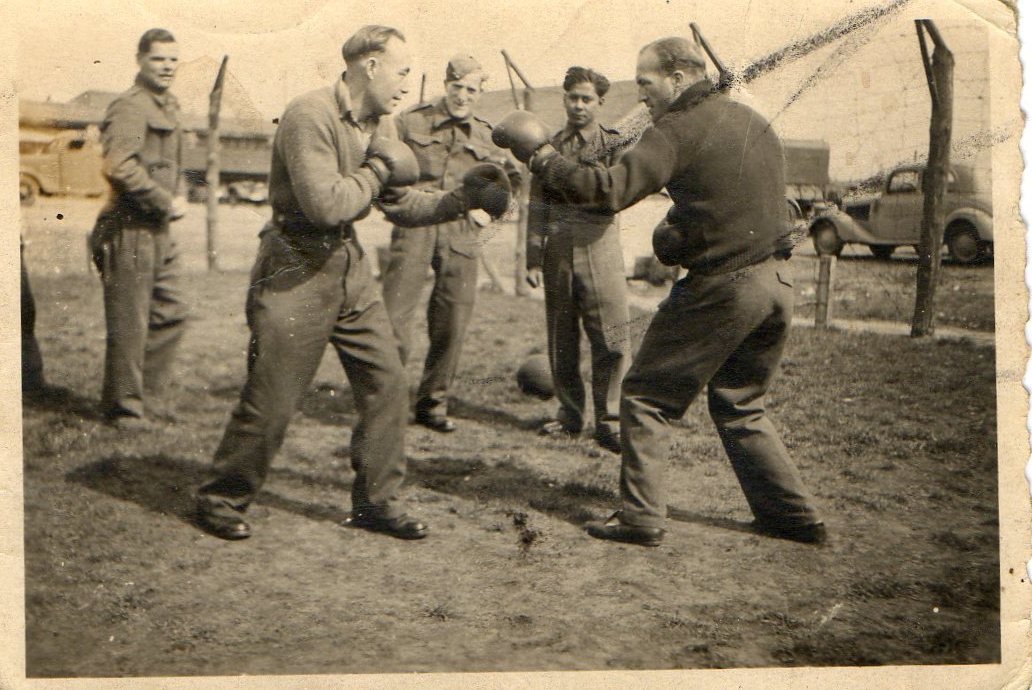
Boxing was allowed for recreational purposes.
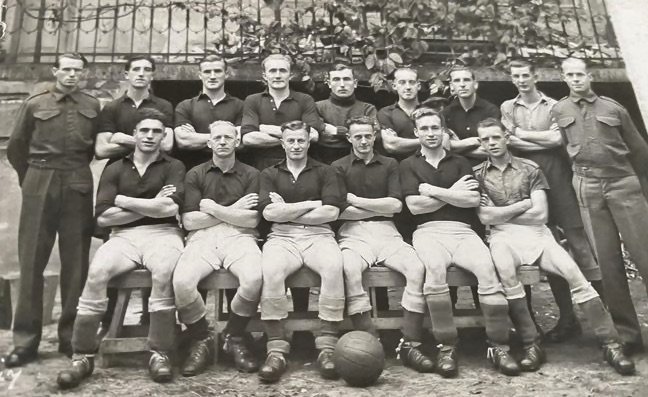
George’s passion was football. His Falkirk team.
Music and drama also featured in camp life. Sam Kydd, the Northern Irish actor was also a POW beside Tom and George. After the war he appeared in more than 290 films, more than any other British Actor. His best known roles were as the smuggler Orlando O’Connor in Crane and the sequel, Orlando. He also appeared in the British Soap, Coronation Street and more. He used his undoubted talent by helping organise plays and other dramatic performances, including comedy sketches. The more musical prisoners would form bands and perform for their colleagues and the guards, who seemed to enjoy them. To quote Tom; ‘even when senior Germans were ridiculed’.
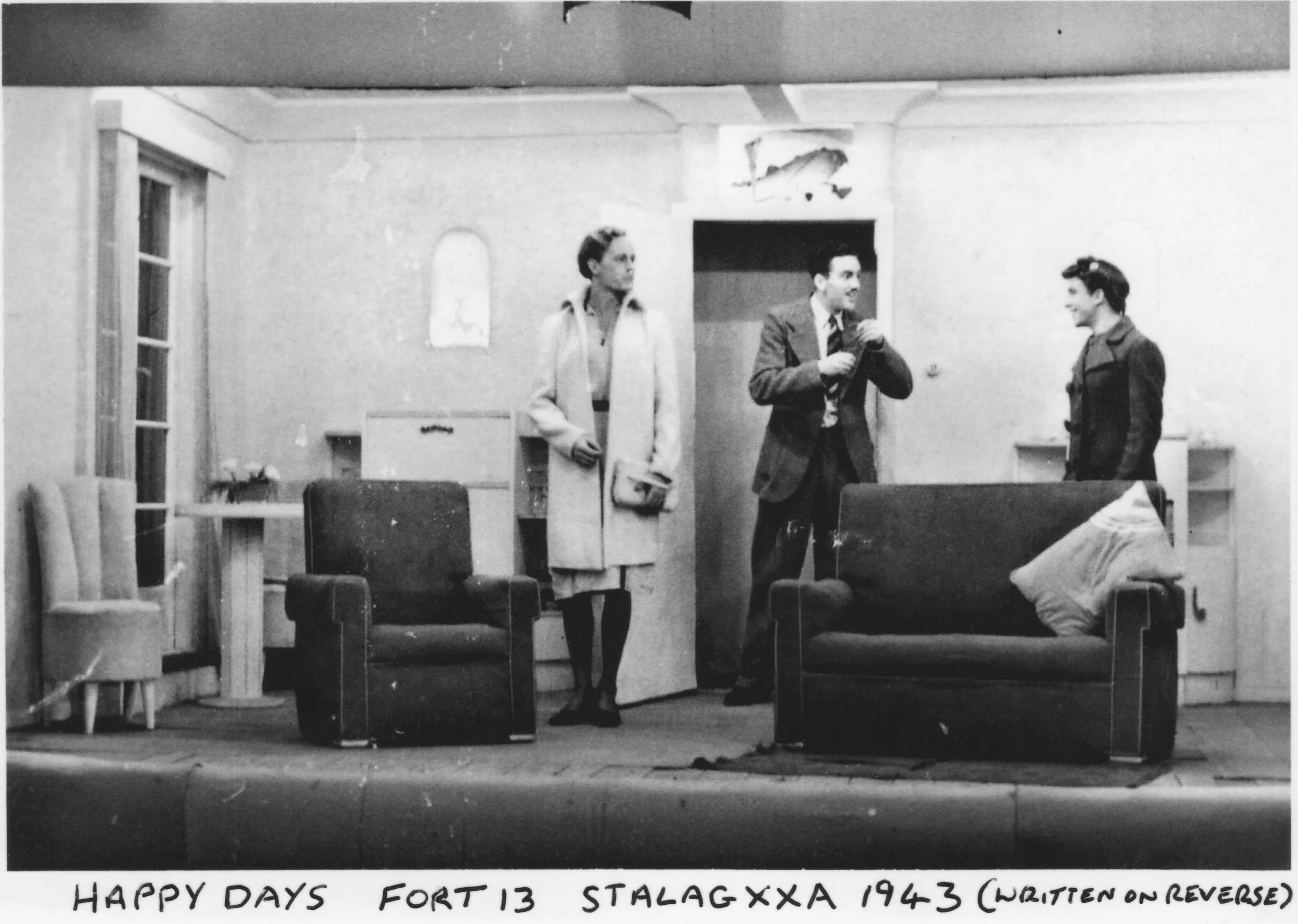
A bit of drama
Another constant in both their diaries, was reference to Red Cross parcels.
Each prisoner was supposed to get one of these every month, but the supply was intermittent. They expressed excitement when they arrived and frustration bordering on anger when the expected delivery was delayed, or on some occasions did not materialise. These parcels contained items that were both scarce and desirable in wartime. American parcels often contained a tin of coffee, a tin of butter, a tin of American cigarettes, chocolate, hard sweets and other items that were otherwise totally unavailable, even to the guards and definitely the local civilians.
While on the one hand the contents of such a parcel would provide an important ‘treat’ for a POW’s personal use, on the other hand and perhaps more importantly, they were essential for trading with the local villagers and were used to barter for eggs, potatoes, vegetables and even fruit, all essential for bolstering the prisoner’s otherwise meagre rations of fifth of a loaf of rye bread and a bowl of thin ‘soup’ each day. There is no doubt that the trading of Red Cross ‘goodies’ to the locals, in exchange for such fresh food, was a crucial element in keeping some from starving. The parcels also lifted the prisoner’s spirits. Tom became quite the egg baron in his camp, trading Red Cross bits and pieces with locals for eggs, before trading the same eggs on again to his fellow POWs.
What there is little doubt about however is that the distribution of Red Cross Parcels increasingly became a bit erratic, particularly in the latter stages of the war and that their whereabouts and availability became an obsession with prisoners desperate to relieve persistent hunger pains.
Both diaries also made reference fellow prisoners being punished. Usually that meant being sentenced to a few days in the ‘bunker,’ to use George’s words, or solitary confinement, to use Tom’s words. It seems George avoided such punishment. Tom was not so lucky. After the ‘diaries’ section I will then go on to recite a few longer incidents they found themselves involved in. One mentioned a prisoner being shot.
The following two entries by George perhaps evidence a more relaxed regime and a change of mood in the camp??
July 10 1943 Guards allow prisoners to buy Schnapps, first time in two years. I got drunk. New camp commandant Feldwebel also drunk, he made our lives a misery, throwing our boots about and making us tidy them up. He cut my bootlaces, his idea of a joke. He then threatened to shoot the men who would not shake hands with him.
July 11 Feldwebel apologises for his behaviour yesterday.
Most of the diary entries I read were simply about surviving from day to day, with the weather, random gossip and camp leisure activities a constant theme. However one subject that was never far from their thoughts was their concern about the fighting and how the Allies were progressing. Following is a flavour of entries that relate to that. They, as did all prisoners, gleaned information from various sources; old newspapers, camp gossip, speaking to villagers when working outside camp, hidden radio’s and even from the guards. The latter probably propaganda to unsettle the prisoners.
Early 1942 and into 1943, George’s diary contained several references about the Italian Army, culminating on April 13 with this statement - Italians capitulate. Later that year they contain more about the German Army and a verging interest on The Russian front.
Sept 7 1942 - Germans still winning. German papers happy about Dieppe.
Sept 14 1942 We recapture Tobruk, Russians capture Leningrad.
Oct 8 1942 Russians break through. U boats in Mississippi. British Empire in trouble.
Jan 4 1943 Russians advancing fast, heavy German losses.
Jan 30 1943 Russians advancing at terrific rate - in Africa Germans surrounded. German newspapers not admitting defeats. The Poles say the war will be over in a year.
June 27 1943 Churchill says, ‘no need for second front,’ followed a couple of days later by Roosevelt, who stated, ‘the war will end in autumn’.
About that point the American influence emerges.
July 1943, German press indignant over allies bombing Rome and British ‘terror bombers’ attacking Cologne Cathedral. Later that month Hamburg was hit three times, the first by 5000 tons of bombs, the third by, to quote the German press, by American ‘Luft’ gangsters. George’s diary, referring to the second attack uses the term, ‘Hamburg again bombed to buggery, Germans angry.’ George’s diary entries take a break at that point and commences again on 21 Jan 1945. About the time they start marching back to Germany. That will feature in the final part (part four) of their story.
Tom’s diary entries are limited as they only cover about four months in total of his incarceration. None of the entries are dated, however each entry has a bit more information than George’s. The first part seems to relate to his early days of confinement, where he spent much of his time in ‘work’ camps, working on the land, in forests and in beet processing. Following are a few examples of his entries from that earlier detention;
‘I was off loading dung, had a good day. At night we loaded two wagons of sugar beet. There is a lot of snow been falling for the last few days. At work I got covered with snow. We had a good snow fight. Asked for a trip to Stalag this week. Guard said it might be arranged. Perhaps I will have some luck on Saturday. Things are pretty bad at present, no Red Cross no mail, but still hoping to have some soon. Going to start a book now, ‘Hash Knife Outfit’. 8.10 o’clock, going to turn in. Played stop patience, one game each’.
‘Started work this morning at 6.30. Received one parcel and 50 cigs, also two letters, one from father, one from Phemie. I had a note from F. McNavae {? Frank McAnae} at Stalag. Wrote to (rubbed out). One of the boys gave me a pair of rubber shoes. We had a game of football tonight, we got beat 1-0. Done a few deals, gave 2 lb of flour and a tin of jam for 1 lb Canadian butter. Gave butter away for three tins of biscuits. Got three snaps of a young pole. Said he would bring me something in the morning’.
‘Stayed in camp today mending boots. The lads were on sugar beet to the station and met a Sgt from another command who said there was a Xmas parcel. Candie (not clear what this word is) parcel and bulk issue in Stalag. The guard tried to arrange for a trip to Stalag tomorrow but can’t manage. Going in on Saturday. Done not so bad today for going to get rations’.
‘Worked on chaff cutting part of the morning. Had a half hour in the billet then went out for half an hour. Steam engine went away today. After dinner I was on root chopping for a little while then when off to get straw (?) of the road got very cold at night. According to the paper they have started to push in the east. Played a little bridge in the evening. Cyril and Yorky were at the distillery today but did not get any drink. Worked till 4 o’clock today. Change of hours half hour extra in the evening. Wrote to Cathie and Father. Nothing interesting happened today. Played bridge in the evening, got beat’.
Entries from second part of his diary seem to be a lot nearer the end of his confinement. The pace picks up and there is references to, what Tom suspects, are advancing Russians.
‘Was in bed until about 4 o’clock. Made a belt for Rick. A lot of excitement over the griff (?) but still nothing definite. Expecting to move anytime. The boys reckon they heard the guns tonight but I did not hear anything myself. Wrote to father and Cathie (my mum). Played stop patience with Brooky and got beat. Had xmas duff for tea. Waiting on the guard to take our slacks (see below), he took them last night for the first time for some time’.
(The Geneva Convention stipulates that prisoners of war must be supplied with suitable clothing. On occasion Tom and his fellow prisoners in Room 32 had their trousers taken away from them at night to prevent them escaping.)
‘The Russians are about here, don’t know what is happening. We can hear the guns. Worked on the saddling half day. In the afternoon worked in the hop’.
‘More excitement, the boss (the German officer in charge) and the workers went to dig trenches but came back at the double as they suspected the Russians were close. They (Russians) have not put in an appearance yet. Got packed to go today but the order was cancelled. We are now about in the front line as far as I can make out. Heard the machine guns today’.
These last three entries must be in January 1945 as they seem to herald the arrival of the Russian Army and not long before the removal of all the prisoners from the camps to be force marched back west into Germany. That will be Part Four of Tom and George’s war.
I will conclude part three with a few short stories, the majority from Tom’s recollection, plus one amazing tale from Don.
Before heading there, a quirky tale; The Third Geneva Convention (Article 34) regarding Prisoners of War, allowed all prisoners the right to practice their own religion and allowed, where possible, access to methods of doing that. It seems that many of the prisoners asked for a bible and were given one. It will come as no surprise to you, when you get to the outcome, that these prisoners smoked. While that same convention allowed prisoners of war to have tobacco, it did not mean that they always had 'made' cigarettes, nor did it specify that cigarette paper be supplied. Desperate people will find a way. The pages of the bible were made of very thin paper. Need I add more?
Following is an interesting, perhaps strange, tale involving Tom and his brother, Jim;
One evening, probably late 1943 or early 1944, when Tom was in one of the work encampments, he was told by a fellow prisoner that there was a guy outside the ‘wire’ wanting to speak to him. Tom at first assumed it was a local that he had met when working outside. When he got to the ‘wire,’ he was taken aback to see it was his brother Jim. A regular soldier, a gunner in the Royal Artillery, who had been fighting in North Africa and whilst on a raid behind enemy lines at Gazella, on 5th December 1941, was captured by Italian forces. Tom had neither seen or heard of Jim since the war started. It seems that when Italy capitulated in 1943, Jim simply walked out of the Italian prison camp. What he did and where he went is a bit of a mystery. Certainly to his family.
Now he had turned up, out of the blue, at the work camp his brother Tom was captive in. Tom remembers that Jim was wearing a sheepskin jacket over what he thought was his uniform. He was in the company of three others, similarly dressed. Tom took them to be American. After a short conversation, the small group quickly melted into the nearby forest. Tom was told to say nothing about this meeting. Tom had no idea how his brother had found him.
After Dad’s death I was doing some research into his war and contacted The Imperial War Museum in London. They maintain the records of all British Prisoners of War. They kindly photocopied the page relevant to my dad’s entry from a much larger document; Prisons of War, British Army, 1939-1945. They had put a mark beside Dad’s entry in that document. When reading it I noticed a second McNeish prisoner, immediately below dad’s name. It was his brother Jim and it showed that he was also in Stalag XXA, Toruń. It appears he was captured in February 1944, this time by the Germans.
At no time did dad ever say his brother and he were in the same camp. I honestly don’t think he knew. A strange encounter.
I will change camps now and bring Don Smith back. Don, after his spell in a prison hospital spent most of his war imprisoned at Stalag VlllB Lamsdorf, Upper Silesia (now Łambinowice, Poland), which had many smaller work camps (Arbeitskommandos) under its jurisdiction.
SGT. FRANK POWERS
Don had been passed fit and worked outside, often in the nearby forest, cutting and chopping logs. One cold winter day, 2 December 1944, when Don and a few other prisoners were in the forest cutting and collecting logs to take back to the work camp they heard the sound of aeroplanes overhead. They jaloused they were American. They were not to know that the aeroplanes they were hearing was a flight of 60 American B24 heavy bombers on a raid to bomb the Polesti Oil Refinery. However, as fate would have it, they soon would know.
The other thing they did not know was that one of these bombers had been struck by anti-aircraft fire and they would soon be joined in the forest by one of its crew, Sgt Frank Powers, who had parachuted from his stricken aircraft and was destined to crash into a tree near where Don was standing.
The same story from Sgt Frank Powers perspective;
‘On our mission on December 2, 1944 there were maybe 60 planes that took off with us over the Adriatic. It was clear weather and our first priority target was the Polesti Oil refinery. We were shot down about 13.30 hours, flying about 20,000 feet. I didn’t have any shoes or boots on because I had been plugged into the suit warmer. The plane was aflame and my clothes were on fire when I bailed out somewhere near the Polish border in Upper Silesia. I pulled the chute cord low to lessen the chance of being spotted. About 9,000 feet I heard dogs barking, then I landed about 60 feet up in a tree. I heard voices and thought it was Germans so I didn’t answer. Then I heard someone shout, ‘he should be down about here’. I recognised the uniforms as British and I hollered at them that I was stuck in the tree. One of them shouted back, ‘Why tell, I say, what are you doing up there?’ Typical British question. I asked them to throw me a knife and I cut the shroud lines and I fell out of the tree onto my ‘ass’. One of them gave me woollen socks. They were Seaforth Highlanders, a Scottish Regiment. Then someone gave me a helmet liner and someone else gave me an overcoat. They hid me in their wood cart, putting wood over me and smuggled me into their camp. Someone gave me shoes. It was not long before the German guards located me in the camp amongst the British prisoners. Because of my injuries, mostly burns, I was taken to the Lazarett (military hospital). ‘
I will round off this remarkable story with Don’s version of how they got him into the camp. Don was worried that the Germans, who were hunting down the crew who had bailed out, would shoot them, so they hid Frank in the wood pile on the back of the waggon. When they got to the gate of the camp, the guards were on alert and searching everything. Don started an argument and struggling with one guard, something that got him punished, but he also caused enough of a distraction to keep them from searching the waggon.
Both Don and Frank survived the war and kept up a friendship for the rest of their lives.
Back to the Geneva Conventions, in particular the one that allowed prisoners to be used for certain work tasks.
The problem, certainly for Tom and a few other prisoners, centred on a term from that Convention; ‘being used for certain work tasks’. That was seen by many prisoners as aiding the German War effort, something they, as far as they could, had no intention of doing.
The attentions of guards therefore had to be divided between two scenarios; stopping prisoners escaping and making sure they carried out the tasks allocated to them.
Meanwhile, on the other side of the chess board, the prisoners, well, many of them, were intent on escape and or not carrying out the tasks allocated to them. Those willing to risk being punished if caught, had a plan. Important was to give the appearance of compliance, yet be aware of opportunities that may arise that would give them a chance to thwart the German War effort, even if only in a small way. Tom called it, a strategy of stealthy irritation.
Such belligerence helped keep their moral high. It also put them in line for punishment if caught, as Tom found out, more than once.
An interesting fact I had no idea existed; prisoners were entitled to be paid for their labour, in camp currency. George suggests that toilet paper was worth more, however, as they did not get toilet paper, camp currency, which was paper notes of various values, did in fact have a value.
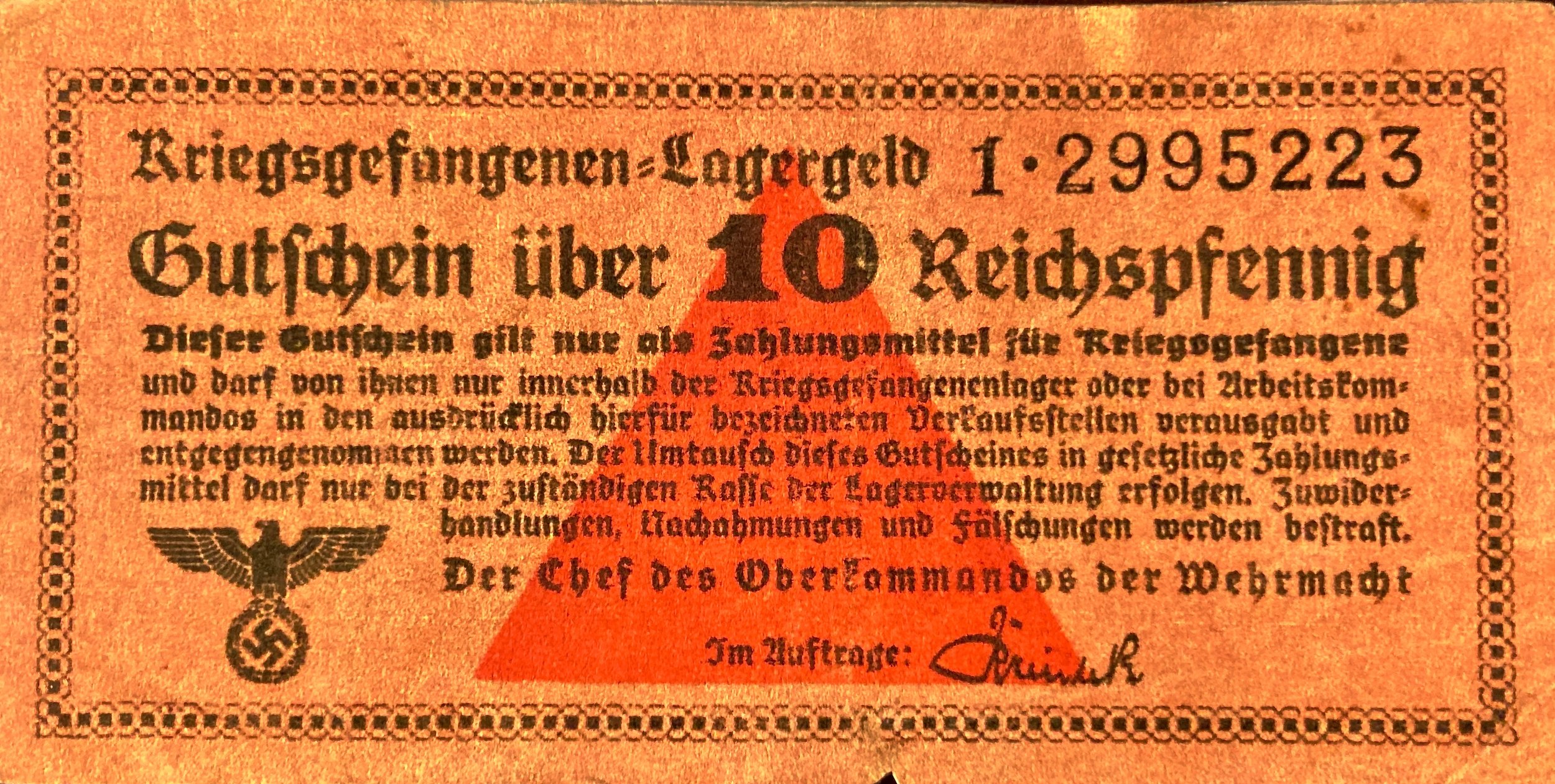
POW camp money to value of 10 reichspfenning.
In terms of the role of guards, scenario one, Tom “escaped” six times, without actually making it back to allied lines. Four of his attempts hardly got him beyond the next village before being caught. Lacking the language, and failing to contact the resistance, being his problem. The other two attempts were marginally more successful, without actually succeeding. The first saw him get a few days of 'virtual freedom' until he reached a major railhead, when he was recaptured. The other 'nearly' escape saw Tom and another prisoner actually getting to the port at Gdansk. They could see a Norwegian ship in the dock, so waited till nightfall before attempting to scale the perimeter fence in an attempt to get to that ship. Part way up the fence, the unmistakeable click of firearms being 'cocked' had the necessary effect and recapture quickly took place. Dad never understood why he did not get shot that night. He did however understand what the alternative punishment was, a beating followed by a spell in solitary confinement, or the ‘Bunker’ as George would have called it.
The next three short stories involving Tom, attest to his belligerence and evidence his strategy of, stealthy irritation.
Planting Beets
It was 1942 and it was a wet, miserable, day down on the farm somewhere in north east Poland, where a working party of allied prisoners of war were hard at work, or were they?
Tom and his fellow working party prisoners were planting sugar beets under the gaze of two armed German guards. The guards had spent time at the start of the day, demonstrating the correct method of planting. This method, as explained by the guards, was to punch a hole in the ground with a wooden ‘dibble,’ cleverly designed by an ingenious German for the purpose, then tenderly placing the precious young plant into the pre prepared hole, roots down, early shoots to the sky. Simple.
It was a two prisoner job; the dibble handler and the planter, who was also the hole closer. The dibble handler, to aid the efficiency of the operation, having created the planting hole, would shuffle up the allocated distance and proceed punching and preparing the next planting hole. Thus making space for the following planter to carry out his task. The operation was like clockwork, just as demonstrated by the armed instruction team. However there was one problem.
This group of seemingly compliant, green fingered prisoners had other ideas. They were, as best they could, intent on doing all in their power to thwart the German War effort and in doing so help the British War effort. Even if just a little. Such belligerence helped keep their moral high. The secret was not to be very obvious, as being shot was always a possibility.
The simple plan involved, energetically and with apparent good intent and saintlike irreproachability, but with sleight of hand, plant the beets, upside down. After a while this unorthodox planting method was spied by the two guards, who strode out into the muddy field and ordered everyone to stop what they were doing. Work immediately ceased and perplexed prisoners stared at the spluttering guards. There followed a few minutes of strange communication, which included, German, pigeon English, some broad Scots and a smidgeon of Polish, supported by feigned surprise, demonstrations of innocence, confusion, oh and the waving of arms and pointing.
Eventually all seemed clear and the apologies flowed, with the plea; ‘sorry, we don’t understand.’ In exasperation the guards laid down their rifles and proceeded to again demonstrate the correct planting method. Prisoners prolonged the ‘lesson’ by continuing to demonstrate their incompetence.
At that point the heavens decided to participate in the pantomime by converting all available water being held in the sky at that moment into a torrential rain storm, turning an already muddy field into a quagmire. All participants in the beet planting escapade, including the guards, exited stage left, at speed, heading for the nearby barn and shelter.
It was not long before one of the guards then realised he had left his rifle in the ‘paddy’ field. The prisoners were unceremoniously ordered back out into the storm to search for the lost rifle. It was soon found and in the true spirit of soldiers, the mud spattered weapon was handed over to its panic stricken owner, the seriously relieved guard.
And so the drudge of prison life continued.
Following is another true tale, this time involving Tom and a touch of engineering.
SPINNY PIVOT
Some of the farms were more mechanised than others. On one occasion Tom was working on a farm that had a steam driven threshing mill, run on holts gas. Like all such steam driven pieces of equipment, it was fitted with a device that regulated the steam pressure, to ensure it did not run too fast, overheat and damage the machinery. That device was a centrifugal governor, or as Tom referred to it, a spinny pivot. Where he came up with that name went with him to his grave. But in remembrance of dad, spinny pivot it will be. The safety device was a simple, rotating central spindle, with two thin metal connected rods attached, that spun around the centrally located spigot. There was a metal spherical shaped weight, like a ball, fitted to the end of each of these rods. As the steam pressure rose, the engine turned and as more pressure was achieved, the engine turned faster. At the same time the spinny pivot also spun faster causing the two metal rods to spin around like helicopter blades and rise higher, from the vertical to the horizontal. When the rods reached a predetermined height, they triggered a device that kicked in and reduced the steam pressure, usually by venting, thus reducing the pressure of steam getting to the engine and preventing it from running too fast and wrecking itself.
Enter Tom, who was really not that interested in too much technical detail, as long as he knew enough to do some damage to the threshing machine. So, as the mid morning break was being taken, some prisoners engaged in a bit of horseplay to distract the guards. Tom saw his chance, got to the threshing machine and removed the spinny pivot, or centrifugal governor, to give it its Sunday name.
After the break, prisoners got back to work, the machine got fired up and threshing commenced. All was going well until a high pitched screeching noise rent the air. As the ‘screeching’ got louder so did the concern of the guards. A sudden loud bang followed by metal being stressed and wood creaking then splintering, brought all eyes on the disintegrating threshing machine. ‘Turn it off,’ came the strangled cries of the Bessarabian guards as they ran about like hysterical earwigs, completely at a loss as to what was happening and at a bigger loss as to what to do about it. It seemed their technical knowledge did not stretch to the complexities of the steam driven threshing machine. And as for the spinny pivot, well that was a universe too far. It was all to no avail, the deed was done and the threshing machine ground to a shuddering and ignominious halt. No more threshing took place that day and some prisoners had to bite the inside of their cheeks to prevent them smiling. Prisoners were bundled into trucks and taken back to the Stalag to be interrogated. And although a beating or two did take place, the culprit was never found. Nor, despite an intensive search, was the spinny pivot.
Some years after the war, a Polish farmer in the far reaches of eastern Poland was emptying the overflowing dung heap, or slurry pit as it is called amongst genteel folks, on his farm, when he came across a rusty piece of metal, like a spigot, with two rusty rods attached, complete with two, just as rusty, balls. Ah, a centrifugal governor he muttered, where on earth did that come from? Or did he say spinny pivot?
Tom was safely back in Scotland by then and the connection was never made.
SUGARS to the BEET
Back to Tom and a tale involving a grape a chute and sugar beets.
Whilst working in a beet processing facility, Tom was up ladders and on a platform. His was to shovel sugar beets down a chute into the processing system. To do that he used a grape (a pronged fork) to shovel the beets down the chute. A simple task really. Anyway, this was not his lucky day and there was an unfortunate accident, probably caused, according to him, by wet mud on the handle of the grape.
Having hitherto wielded it so skilfully it was a shock when the grape unexpectedly took on a life of its own and miraculously flew out of his grasp and, after teetering on the edge of the processing machine for what seemed like an eternity, suddenly and without warning took off down the chute, like a rat up a drainpipe, or in this case, down a chute, straight into the sensitive machinery. There followed a few minutes of earsplitting squealing and grinding before the whole process ground to a halt. An eery silence then ensued, followed by guards running hither and yon about the factory. Suspicion soon fell on Tom and he was unceremoniously dragged away for interrogation concerning the circumstances of this ‘suspicious’ incident. During the questioning, he continued to protest his innocence, claiming it had been an unfortunate accident and that the grape had slipped from his grasp and fallen down the chute.
He was not believed and was asked to write down his version of events. In doing so he created a second level of panic. Due to language difficulties and perhaps his state of mind at the time, when writing what had happened, particularly the chute part, his spelling let him down and for chute he wrote, ‘shoot’. The other part of his explanation that did him no favours, was his use of the word ‘grape’, an old Scottish word for an agricultural fork, used mainly when harvesting potatoes. Whilst a common enough word for Tom, who was relaxed in using it, his German interrogators were not so relaxed. In fact they were far from relaxed. Urgent glances passed between the small bald men with metal rimmed eye glasses, already on high alert with the word shoot. Now they were grappling with the word grape and its obvious connection to grapeshot. Panic! Reinforcement were immediately summoned and the factory, along with the nearby living quarters, were torn apart in their search for the non existent firearm and grapeshot ammunition. When nothing was found, already frayed tempers became unravelled, and like ‘The Grapes of Wrath’, unpleasantness and threats of a firing squad proliferated .
Eventually things calmed and a bruised and bleeding prisoner got two weeks in solitary confinement and remained breathing.
So, like Shakespeare, Tom was inventive with his word use. Unlike the Bard however, such inventiveness was not always carried out wittingly or to his advantage. Perhaps the words from Hamlet; ‘sweets to the sweet’ may have appeared in Tom’s writings as; ‘sugars to the beet’.
This story, the last of part three, is not about being reluctant to work, no, it is about something potentially far more dangerous and perhaps irresponsible. Maybe not, it is however a tad tangled and complex, so concentrate.
MIXED IDENTITIES
Back to east Poland, sometime in 1943. Tom is heading to the shower block for what he referred to as ‘de lousing’, however hiss life is about to get a bit complicated as he encounters another misadventure.
The shower block was busy with officers and enlisted men, preparing to return to their respective confinement zones. Tom and his colleague, McNair by name, patiently waiting on trucks to take them back to the ‘work camp’ . The officers on the other hand were just about to walk back to the Stalag. Officers did not get used for working parties.
As the prisoners were milling about, prior to being herded in the direction from whence they came, two officers approached Tom and his colleague McNair and suggested they swop places. ( I never did established the rank of the officers ). The officer’s said they were bored by being locked up in the prison camp with little to do and they would love to get outside the wire for a time and work in the open air. When Tom said it was sometimes harsh conditions they worked in, the truth came out. The officers had no real plans to work on the farm and really wanted the chance to escape, something it would be easier to achieve if they were outside the stalag and part of an outside working party. Tom and McNair agreed, partly because they were fed up labouring on farms and being in the camp would not only be a change. It would get them some respite from, to quote Tom, ‘cawing their pan in,’ day in and day out on. A quaint Scottish expression meaning, ‘working very hard,’ well according to Tom. The consequences of being ‘found out’ seems not have been a consideration.
So, name tags, were exchanged and four prisoners, well, two pairs of prisoners to be accurate, wandered off to their ‘alternative’ accommodations, each looking forward to experiencing a different prison regime, for a while. As they, McNair and McNeish were being transported to their new billet, they thought through what they had done and saw a flaw in the plan. In short they overthought their situation.
To explain, McNeish, my dad, was 5’8” in height, his colleague McNair was 5’11”. The two officers were also different heights. In the rush to change identities, each swapped with the wrong person. Tom was wearing the identity tag of the taller officer, McNair, on the other hand, was wearing the identity tag of the smaller officer. McNair and Tom, then interchanged identities. Their logic being, that by doing so, the names would fit the height and perhaps the guards would be less likely to detect their little subterfuge when being checked back into camp.
This double inter swap never reached the ears of two officers, who continued their plan, oblivious of the confusion that was about to unfold.
For a while things rolled along, however it could not last, the four involved would never get through the war, continuing to pretend they were someone else. The other fly in the ointment of the officer’s master escape plan was somewhat more dramatic. They, now masquerading as McNair and McNeish, did make a bid for freedom and wandered off into the Polish country side only to be recaptured before they had gone very far.
Enter into the plot men with small round glasses and long coats. Interrogations commenced and the true identities were soon uncovered. Well, nearly.
The officers now with their proper identities restored, each received 21 days solitary confinement. McNair and McNeish were soon drawn into the dastardly escape plan. Further confusion was now about to kick in. McNeish was also sentenced to 21 days in solitary, same as the officers. But it was not a McNeish who languished in solitary, it was actually McNair. The clever and confusing double interchange of identities between McNeish and McNair had not yet been discovered.
The real McNeish, yes Tom, had received a bad knee injury and was in the camp hospital, receiving treatment, under the name of the smaller of the officers. It was during that time that the same bespectacled, long coated interrogator called to see him. He sat on the bed, leaned forward and spat these words into Tom’s face. ‘You cannot fool us, we know exactly who you are, you are not an officer, you are private McNair.’ With that he leaned over, snatched the officer’s identity tag from Tom and threw a different identity badge onto the bed and stormed out, only looking back to snarl, ‘and don’t think this is finished, we will be waiting for you when you get out of this bed.’ After he left, Tom picked up the identification tag. Oops, it was not his, it was McNair’s. The subtle and confusing identity interchange plot had only been partly uncovered.
The identity confusion was eventually discovered and McNair and McNeish were restored to their correct names and got reunited with their own identification tags. Tom was still in hospital at that point. The name at the end of his bed, much to the confusion of the nurses, had been changed three times and was now correct; McNeish.
The punishment process, like all processes, rolled on, and in its unthinking eyes, only three of the four miscreants had served their punishments. According to the ledger, two officers and ‘McNeish,’ had done their time. Who have we missed, ah, McNair. The unfortunate McNair was sent to solitary to serve his 21 days. He had now served 42 days in the ‘bunker’. 21 days as McNeish and the second 21 days as himself.
And it came to pass that the real McNeish, under his own name, eventually limped out of hospital and escaped any form of punishment.
McNair and Tom met at reunions after the war and McNair’s opening greeting to dad was always the same, ‘McNeish, I have done time for you.’
And he was not lying.
Whilst understanding that many really suffered in the camps, I have related George, Tom and Don’s stories in a way, that whilst absolutely true, missed out some of the hardships. There was so much more I could have included, however it is my hope that what I did include brought the reader some some understanding of prison camp life in a way that not only informed you, but also entertained you.
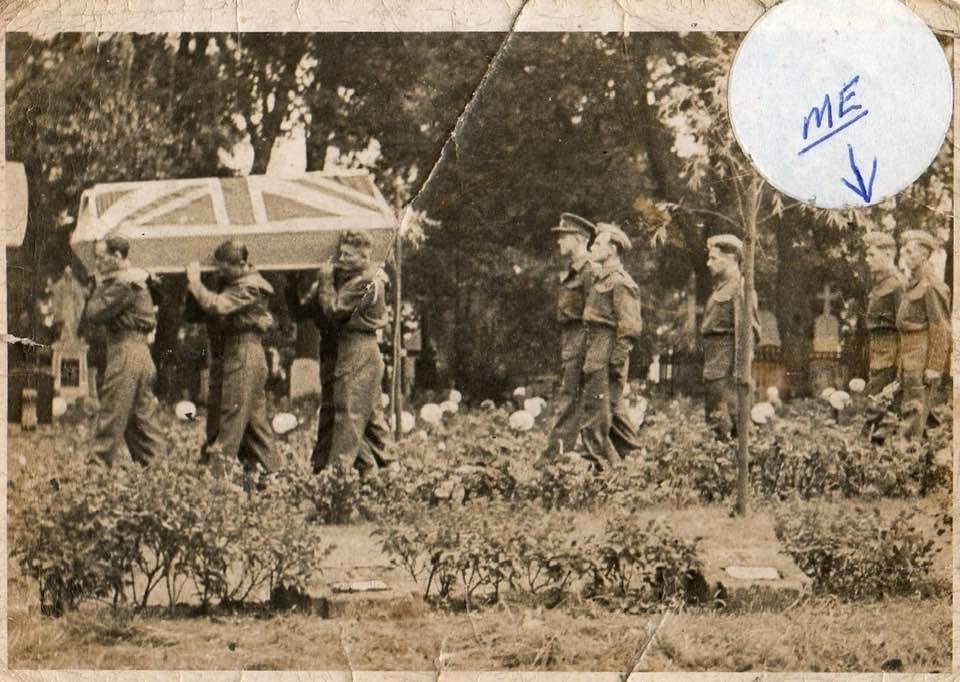
The funeral of Danny Faulds, a prisoner of war who died in Stalag XXA, Toruń
Danny Faulds died while in captivity at Stalag XX-A. The exact circumstances of his death are not widely documented, but it reflects the tragic fate of many POWs who endured extreme hardships during their internment. The camp's history is marked by the suffering of its occupants, and Faulds' story is a part of this larger narrative of wartime experiences. The pall bearer at the front, nearest camera is Sam Kydd, behind the coffin, arrowed, is Tom.
Danny Faulds was an Argyll and Sutherland Highlander, one of the Scottish Regiments that formed the 51st HD. He was from Longcroft, a village less than ten miles from where Tom was brought up.
Thank you for reading to the end. I invite you to add any comments you may have.